Michael Millevolte, Analog Light Architect and Luminous Optomechanical Illusionist
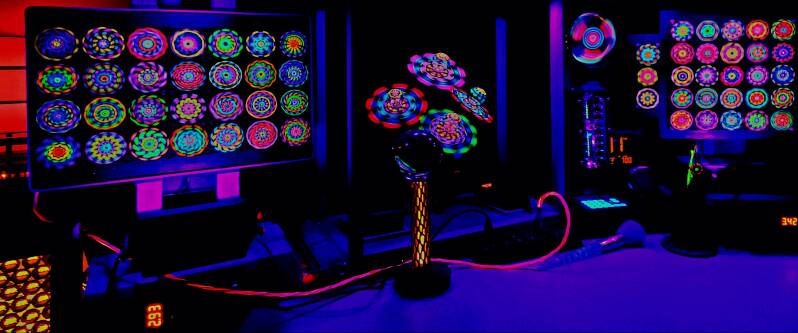
40 Hand-Crafted Luminous Creations and Proprietary Inventions by Light Artist Michael Millevolte. 1986–2026
I. Ultraviolet Fluorescence, Stroboscopic Animation, and Motion 1986-2026:
1] Two-Dimensional Luminous Fluorescent City-Scapes 1986-1987
Description: Specially selected calendared moonlight paper, fluorescent "neon" pigments, Kodak black masking tape, pencil and pen, along wth flourescent pointillism including shading with light with a needle.
Notable Exhibitions: Little Louie's Place and Open 24 Hours sold to private collections.
2] Two-Dimensional Luminous Fluorescent Kinetic Forms and Hand-Painted Geometric Color Delivery Systems 1986-2026:
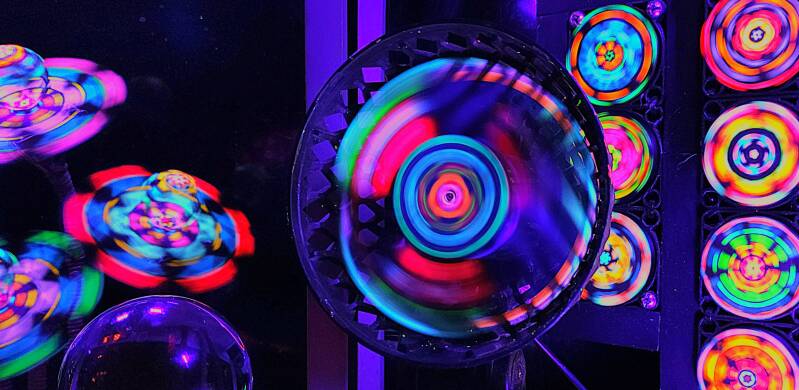
Description: UV blacklight-reactive fluorescent geometric patterns hand-painted onto rapidly rotating blades and surfaces. Persistence of vision transforms the physical forms into larger luminous, transparent geometric mandalas seemingly suspended in space.
Notable Exhibitions: The World Nightclub [debut exhibition, UV blacklight-reactive box fans], New York City. Scrap Bar [kinetic wall installation], New York City. El Teddy's Restaurant [kinetic window displays and Cosmic Marine Aquarium], New York City. Antique Boutique [fluorescent ceiling fans and stage lighting], New York City.
3] Three-Dimensional Luminous Fluorescent Kinetic Forms and Hand-Painted Geometric Color Delivery Systems 1986-2026:
Description: UV blacklight-reactive fluorescent kinetic sculptures incorporating rotating globes, cylinders, teardrops, triangles, and other three-dimensional geometries. Mechanical rotation transforms physical structures into luminous volumetric forms occupying time and space.
US Patent #5,704,145, Point of Purchase Spinning Display (January 6, 1998).
US Patent #6,018,899 Rotating Display (February 1, 2000)
Notable Exhibitions: Toots and The Maytails Concert Performance [fluorescent teardrop mandalas], New York City. Central Park Boathouse Ticket Office [fluorescent kinetic sculptures], New York City. Nickelodeon Lobby [fluorescent Saturn globes], New York City. El Teddy's Restaurant [three-dimensional fluorescent mandalas], New York City. TED Conference [38 Philco Upper Assembly], Monterrey, CA.
4] Flickering Fabric Flames 1993:
Description: Vertically propelled UV blacklight-reactive stipple painted fluorescent pigments applied to black silk fabrics produce continuously changing luminous flame-like forms through forced airflow without combustion.
Notable Exhibitions: El Teddy's Restaurant [fluorescent flame window installation], New York City.
5] Waving Kinetic American Flag [Fluorescent Holographic Panels 1992]:
Description: UV blacklight-reactive fluorescent imagery distributed across 25 independently moving acrylic panels arranged in a five-by-four foot configuration. Repeated stars and stripes generate a changing kinetic optical field with holographic-like visual effects.
Notable Exhibitions: Millevolte Elizabeth St. "Up All Night" Storefront Gallery, New York City, El Teddy's Restaurant [ongoing window display], New York City.
6] Magnetic, Air Propelled and Mechanical Pendulums [Fluorescent Geometric Butterfly 1993 and Attacking Spider 1986/1995]:
Description: Tether Suspended UV blacklight-reactive fluorescent kinetic sculptures employing magnetic interaction. Unpredictable movement generates butterfly-like and spider-like behavior, luminous geometric patterns, and pointillistic optical effects.
Notable Exhibitions: El Teddy's Restaurant [Magnetic Butterfly], New York City. International Robotics Showroom [Attacking Spider], New York City.
7] Roman Candle Streak Effect [Levitating Ball Machine 1989]:
Description: UV blacklight-reactive fluorescent kinetic sculpture incorporating hand-painted UV blacklight reactive Styrofoam balls Continuous movement creates changing spatial relationships and luminous optical patterns.
Notable Exhibitions: Freghatten Nightclub [Ball Machine], Sweden. El Teddy's Restaurant [fluorescent kinetic installation], New York City. Limelight Nightclub [Ball Machine], De Pere, Wisconsin.
8] Two-Dimensional UV Blacklight-Reactive Zoetropes [Tasmanian Devil 1995]:
Description: Sequential fluorescent imagery arranged on a large rotating disc placed on a modified record player. Temporally modulated ultraviolet illumination transforms individual images into continuous animated movement through the stroboscopic effect.
Notable Exhibitions: Millevolte Gallery [debut exhibition, 1995], New York City.
9] Three-Dimensional UV Blacklight-Reactive Zoetrope [Ornamental Lizards 2004]:
Description: Three-dimensional fluorescent lizard sculptures arranged sequentially on a rotating disc fixed to modified record player. Stroboscopic ultraviolet illumination creates the illusion of brightly colored lizards crawling outward from the center.
Notable Exhibitions: TED Conference 2004 [Ornamental Lizards], Monterey, California.
10] Three-Dimensional UV Blacklight-Reactive Zoetrope [Insect Swarm] 2004:
Description: Repeated three-dimensional fluorescent insect sculptures fixed to a rotating radial carousel. Temporally modulated ultraviolet illumination transforms individual forms into an animated swarm.
Notable Exhibitions: Eric Schmidt Residence [Halloween Funhouse], Beverly Hills, California.
11] Three-Dimensional UV Blacklight-Reactive Stroboscopic Zoetrope [Abstract Geometric Animation Fields] 2026-2027:
Description: Sequential fluorescent geometric forms arranged on rotating structures. Temporally modulated illumination transforms individual geometric patterns into continuously evolving abstract animations.
Notable Exhibitions: Millevolte Studio Work in Progress [2026-2027]
12] Hyper-Electra [Rotating Dual Fluorescent Mandalas 1992]:
Description: Two UV blacklight-reactive fluorescent mandalas mounted on opposite sides of a vertically rotating structure. Mechanical rotation alternates the luminous geometric patterns within the observer's field of view.
Notable Exhibitions: Millevolte Storefront Gallery, New York City.
13] Jitterbird [Eccentric Oscillating Kinetic Fluorescent Sculpture 2026]:
Description: UV blacklight-reactive fluorescent kinetic oscillating sculpture employing an eccentric rotating counterweight and spring suspension. Variable speed oscillation tuner generates horizontally mirrored luminous flapping waves, S-curves, figure-eight loops, and cones flanking independent concentric geometric mandala eye.
Notable Exhibitions: Millevolte Private Collection.
14] Desktop Solar Flare 2026:
Description: UV blacklight-reactive fluorescent kinetic sculpture combining rotating geometric forms with interacting LED flame array and rotating blade silhouette. Mechanical movement generates changing luminous patterns combined with mid layer rotating blade silhouette.
Notable Exhibitions: Millevolte Studio Interactive Kinetic Display Modules.
15] Modular Shadow Fan 2026:
Description: UV blacklight-reactive fluorescent kinetic sculpture incorporating hand-painted rotating fan blades and fixed housing induced shadows cast on fluorescent kinetic geometric patterns, mechanical color separation, changing blade orientation, blade depth and interacting shadows generate luminous linear pulsating geometric patterns and optical progressions.
Notable Exhibitions: Millevolte Studio Interactive Kinetic Display Module.
16] Cosmic Windflowers [Sunlit Night Blooms] 2026:
Description: UV blacklight-reactive fluorescent kinetic solar powered sculptures incorporating rotating geometric forms and luminous colors. Variable speed drive movement generates luminous flower-like structures that appear to expand, contract, and reorganize in space.
Notable Exhibitions: Millevolte Light Works Private Garden.
17] Cosmic Garland and Cosmic Weather Vane [Wind-Driven Dynamically Balanced Rotating Inertia Blades with Fixed Flywheels]. 2026
Description: Inspired by the workings of a sundial and a clock and pendulum, Cosmic Garland explores the persistence of kinetic motion through time and space influenced by natural forces, fluid dynamics, and rotational inertia. Fixed orbital weights change how the aerodynamic blades respond to shifting winds and inertia generating graceful waves of movement and the visual impression of luminous motion decaying through space and time.
Notable Exhibitions: Release Date: Late Fall of 2026.
II. Focused Oil and Overhead Light Projections with Optical Surface Transformations:
18] Kinetic Oil Projections on Melting Ice 1993-1997:
Description: Aurora Borealis effect, shape-shifting illuminated colored oil transparencies directed through semi-transparent sculpted ice. Refracted light and continuously changing colors transform stationary ice sculptures into luminous color and form phasing objects.
Notable Exhibitions: Millevolte Storefront Gallery Annual 4th of July Celebrations [Joe "The Ice Man" O'Donoghue Collaborations], New York City.
19] Aurora Flame (1993):
Description: An air-suspended kinetic light sculpture employing forced airflow to continuously animate a lightweight, translucent white silk surface. Illuminated by slowly changing colored projections generated through a rotating oil disc and overhead projector, the undulating fabric produces flowing, aurora-like formations reminiscent of the northern lights. The interaction between air movement, translucent material, and projected illumination creates an evolving three-dimensional display of luminous color. Developed from Millevolte's earlier air-animated fabric installations at El Teddy's restaurant in New York City, Aurora Flame represents an early exploration of moving projection surfaces as an alternative to conventional static screens.
Notable Exhibitions: Millevolte's New York City gallery (1993), where the sculpture was experimentally operated and evaluated over several days and was determined to be too bright and conflicted with other works.
III. Kinetic Laser Systems:
20] Kinetic Laser Copter 2013:
Description: Kinetic laser sculpture incorporating mechanically rotating laser diodes and a mirror-ball attachment. Rotational movement distributes laser beams into changing geometric trajectories and luminous volumetric patterns.
Notable Exhibitions: Luna Nightclub, Appleton, Wisconsin.
21] Laser Fan Tapestry Generator:
Description: Kinetic laser projection system employing rotating apertures and mechanical light modulation. Moving laser beams generate fan-shaped patterns, vertical geometric fields, and moiré-like optical structures.
Notable Exhibitions: Plastered Pilot Production Studio, De Pere, WI. Not Yet Displayed in Public
22] Magnetic and Air-Driven Perpetual Laser Pendulum:
Description: Kinetic laser sculpture incorporating suspended laser diodes, magnetic interaction, and air-driven mechanical movement. Unpredictable horizontal oscillations generate luminous geometric patterns and sweeping laser trajectories across architectural surfaces, laser beam end-points generate volumetric scribbles on upper walls and ceilings or stacked angular surfaces .
Notable Exhibitions:
IV. Projection Mapping Matrices and Fabrics:
23] Balls to the Wall V1 Nested Matrix [Translucent Balloon Projection Matrix] 2013:
Description: Three-dimensional projection matrix incorporating repeated spherical balloon surfaces. Projected imagery is distributed across individual curved surfaces, transforming conventional two-dimensional images into fragmented dimensional optical patterns.
Notable Exhibitions: Winter Warmer Festival, Oconomowoc, WI.
24] Balls to the Wall V2 Nested Matrix [Ping-Pong Ball Projection Matrix] 2015:
Description: Three-dimensional projection matrix incorporating thousands of uniformly arranged ping-pong balls. Digital imagery projected across the spherical surfaces generates luminous dimensional patterns and fragmented geometric visual fields.
Notable Exhibitions: D2 Sports Pub, Appleton, WI, The LED Room at OB's Brau Haus, Appleton, WI.
25] Halo-Eye Nested Matrix [Aperture Ping-Pong Ball Projection Matrix 2026]:
Description: Three-dimensional optical matrix incorporating uniformly arranged ping-pong balls with drilled apertures. Light entering the spherical cavities creates visible depth, illuminated interior surfaces, and changing geometric relationships.
Notable Exhibitions: Cattle Rest Saloon and RV Park, Willcox, AZ.
26] Marble-Eye Nested Matrix [Compound ping-pong ball apex embedded marble matrix] 2026:
Description: Three-dimensional optical matrix combining hollow ping-pong spheres with partially embedded transparent marbles. Light transmission, refraction, and concentrated highlights generate a field of sparkling, diamond-like optical effects.
Notable Exhibitions: Millevolte Studio Work in Progress.
27] Infinity Flame [Programmable Air-Suspended Kinetic Projection Surfaces]
Description: A contemporary evolution of my Aurora Flame (1993), incorporating programmable digital projection mapping onto continuously moving, air-suspended translucent surfaces. Rather than relying on the original rotating oil disc to generate shifting colors, Infinity Flame employs digital imagery, animation, geometric patterns, and virtually unlimited visual compositions. Controlled airflow continuously reshapes the suspended material, introducing physical motion, dimensional variation, and changing surface geometry into the projected imagery.
Notable Exhibitions: Work in progress. Initial configurations planned for experimental integration with the Ping-Pong Matrix.
V. Kinetic LEDs and Marble Matrix Screens:
28] Marble Matrix Circular Mandela:
Description: A rotating LED mandala positioned behind a matrix of transparent marbles. Each marble independently modifies the moving illumination, redistributing the original geometric image into a secondary field of luminous optical events.
Notable Exhibitions: Sold [private collection].
29] Marble Matrix Orbital Mandela:
Description: Three-dimensional rotating LED orb positioned behind a transparent marble matrix. Changing spatial relationships between individual LEDs and marbles generate continuously evolving luminous patterns and optical transformations.
Notable Exhibitions:
30] Marble Matrix Micro-Burst [Optical Pixel Tuner]:
Description: Dense matrix of transparent marbles illuminated by miniature LED light sources. Individual marbles modify and redistribute concentrated points of illumination, producing a field of luminous microbursts and sparkling optical pixels.
Notable Exhibitions:
31] Marble Matrix Micro-Burst Cubed [3D Squared Optical Pixel Tuner:
Description: Three-dimensional optical matrix incorporating transparent marbles arranged across multiple surfaces of a cubic structure. Internal LED illumination generates changing luminous patterns visible through the surrounding marble surfaces.
Notable Exhibitions:
32] Marble Matrix Micro-Flames 2026:
Description: Transparent marble matrix illuminated by animated LED light sources. Moving illumination is individually modified by the marbles, generating secondary luminous patterns resembling animated flames.
Notable Exhibitions:
VI. Kinetic LEDs and Free-Motion Systems:
33] Squiggly Wiggly 2018:
Description: Kinetic LED sculpture incorporating suspended LED string lights connected to an eccentric motor through a flexible tether. Mechanical imbalance, inertia, and unrestricted movement generate unpredictable luminous trajectories, waves, firefly swarms, and animated oscillating patterns.
Notable Exhibitions: Millevolte motorhome kitty condo, private collection owned by Rizzo, Snoops, Poppy, Mumma and Biskit.
34] Firebox [Simulated Desktop Fireplace] 2026:
Description: LED optical sculpture incorporating layered hardened perforated paper-towel screening, diffusion panel and flattened solar torch array, interacting light and materials generate continuously changing luminous patterns resembling animated fames and fire.
Notable Exhibitions:
35] Twinkling Tablet 2026:
Description: Defective computer tablet display screen positioned in front of a mult-mode LED grid matrix with phone app and remote. The screen's internal optical materials modify individual points of light, generating a starburst-like field of luminous "twinkling" colors.
Notable Exhibitions: Millevolte Motorhome Studio Collection.
36] Freakin' Beacon 2022:
Description: Repurposed construction beacon incorporating LED kinetic orb illumination. The beacon's original lens geometry modifies and redistributes kinetic LED light, transforming a conventional warning device into a luminous optical sculpture.
Notable Exhibitions: Sold to private collection.
37] Flaming Beacon [Flaming Torch Array, Modular Backdrop Interaction]:
Description: Repurposed construction beacon incorporating a modified solar-powered LED array. Sequential illumination interacts with the beacon's optical geometry, transforming linear LED movement into apparent curved, circular, and rotating luminous bands.
Notable Exhibitions: Millevolte motorhome workstation and experimental display module.
38] Limpetland [Multi-Mode LED Shell Matrix]:
Description: Three-dimensional luminous matrix incorporating natural "leopard-like" patterned limpet shells suspened slightly above a hardened sand surface, cholla stalk stem with construction beacon LED and cylindrical light diffuser, and programmable mult-mode LED organic grid matrix with phone app and remote. Variations in shell geometry, coloration, intensity and shell translucency.
Notable Exhibitions: Millevolte Motorhome Studio Collection.
39] Synchronized Multi-Mode LED "Liquor Lamp" Glass Bottle Linear Matrix [Expandable] 2026:
Description: Three-dimensional luminous matrix incorporating transparent bottles containing individually positioned multicolor organic matrix, multi-mode LED wire with phone app and remote. Synchronized electronic controllers coordinate changing colors and illumination patterns across multiple bottles with sound reactive mode generating a larger volumetric field of animated light.
Notable Exhibitions: Millevolte Motorhome Studio Table display [live exhibition pending].
VII Laser Reactive Photoluminescent Kinetic Light Sculptures:
40] Laser Reactive Photoluminescent Rotating Blades, Globes and Overlapping Tapestries. 2026-2027:
Description: An older idea of mine that got cut cut short as a result of the tragedy at Luna Nightclub in Appleton. This kinetic sculpture combining mechanical rotation, directed laser excitation, and photoluminescent persistence to generate evolving and decaying rings and circular streaks of luminous colors designed to resemble rings from falling raindrops on puddles.
Originally conceived and illustrated in 2013, this system employs a series of rotating blades coated with photoluminescent pigments. Precisely targeted laser pulses excite selected regions of the rotating surfaces, producing concentric rings and other geometric patterns.
Unlike conventional fluorescent illumination, the phosphorescent pigments retain their luminosity after excitation, allowing successive patterns to overlap, accumulate, and gradually decay into complex, continuously changing tapestries of light.
Notable Exhibitions: Millevolte Light Works Studio Work in Progress.
© 2026 Michael Millevolte. All Rights Reserved.
Original artwork, luminous geometric compositions, and associated artistic terminology are subject to applicable copyright and trademark protections. Proprietary optomechanical inventions, mechanical systems, and functional applications may be subject to utility patent protection. All applicable rights reserved.