

Tug of a Pull-String Switch

Introduction to My History by Michael Millevolte:
The Tug of a Pull-String Switch:
An introduction to the nearly 40 year career of multiple medium light sculptor Michael Millevolte.
Moving into new housing in Madison, Wisconsin, I discovered a single blacklight bulb left behind in a closed closet by the previous tenant. Upon switching it on, I was amazed to see my everyday fluorescent magic-marker highlighters, which happened to be sitting on the floor beside a notebook I was about to study, instantly transformed into intensely radiant, seemingly self-illuminating colorful objects. Driven by this newfound fascination with the blacklight effect, I eventually began experimenting with fluorescence and high-speed motion to create cosmic, space-like imagery. Rigging a metal pie tin to an old air-compressor motor, I used the high-speed spin to splatter fluorescent paint outward onto a canvas.
The breakthrough came after the paint left on the delivery pie tin had dried. While spinning the now paint-covered tin at very high speed beneath my fluorescent-tube blacklight, I caught a slight glint of a geometric pattern emerging from what had previously been a chaotic mess.
Recognizing the implications of the discovery, I shifted within hours from random splatters to intentional engineering, painting intricate, calculated geometric mandalas directly onto assorted rapidly rotating blades.
When spun at high speeds, the fluorescent blades seemingly expanded, generating luminous, transparent, geometric mandelas floating magically above the air compressor motor. Soon I was scavenging for anything that could spin fast enough to create the bright and very colorful illusions.
Armed with this definitive, proprietary concept, I packed my bags less than a year later and moved to Long Island to pursue a career in New York City.

Tripp'n Times and Checkers On The Governor's Desk:
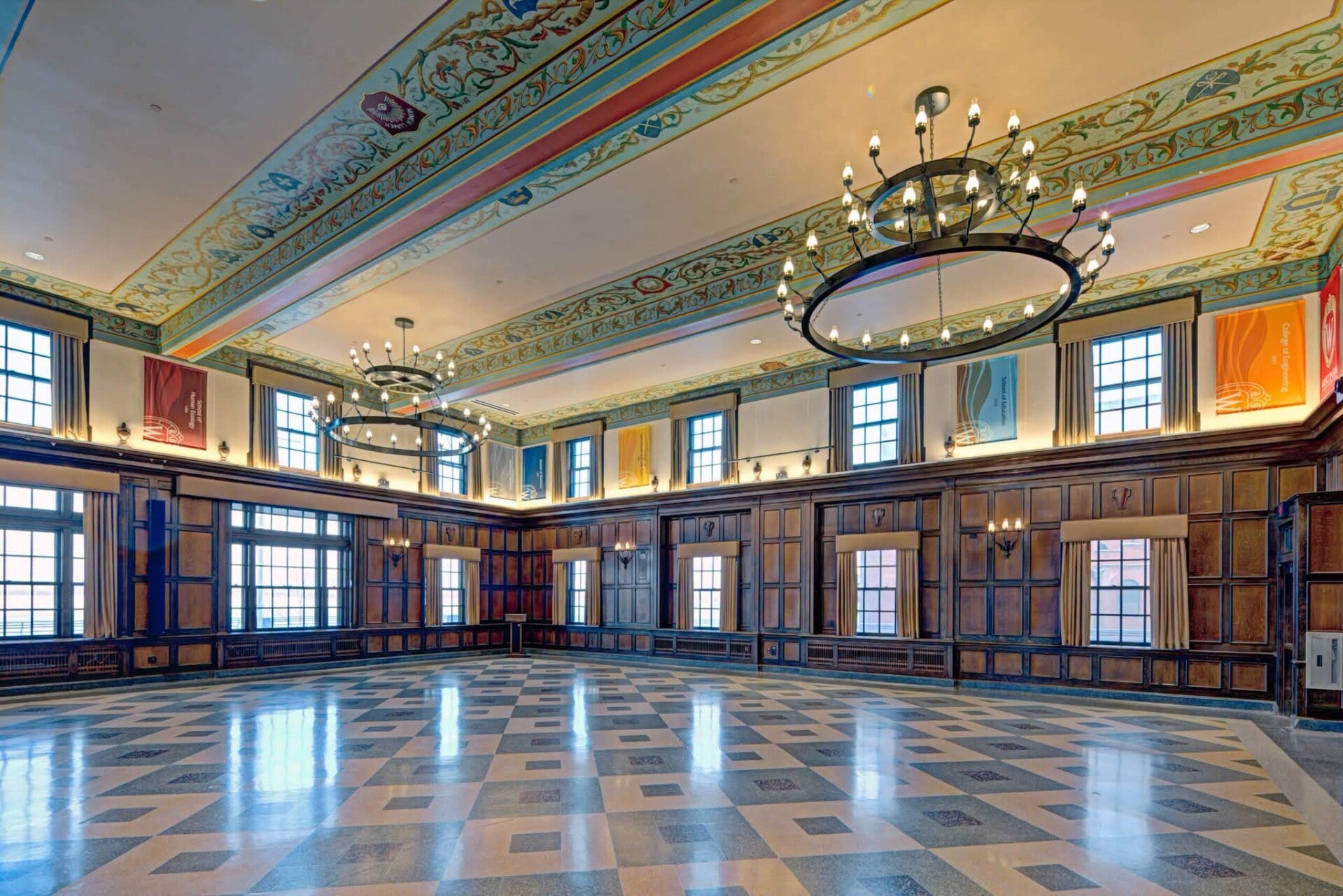
Nearly every weekday morning of my final year attending classes at UW–Madison, I clocked in to take on my duties as a cart "trucker" at Tripp Commons. The Commons was a beautiful dining space located on the second floor of the Memorial Student Union in Madison, Wisconsin.
The tasks of a trucker were vital to the day-to-day operations at the Commons. It was my job to navigate the building's vast basement labyrinth of hallways, storage rooms, and walk-in freezers to collect a long list of items and ingredients needed to prepare the midday meals for dozens of UW faculty members, professors, teaching assistants, and custodians.
Not only did I need to get everything requested, I had to accomplish my tasks as quickly as possible in order for the cooks to begin preparing their daily offerings. Everything had to be packed and stacked in a precise way so all the items would fit on a single cart load. One mistake or forgotten item could set everything off schedule, and any delays were unacceptable. Thankfully, I enjoyed the job and was very good at it. As a result of my efforts and dependability, I was allowed to relieve some of the stress and goof off a little bit more than others.
I quickly gained a reputation with my boss for being a little bit of a nut job after she once caught me eating food from a cart of leftover scraps from those who didn't finish their meals. She had no idea that it was fresh food taken from the kitchen that I had put on a tray of my own, strategically placed along with all the others.
Near the end of my shift, I had the undesirable job of clearing all the trays filled with plates and bowls of uneaten food and getting them prepared for the dish room. The biggest challenge was preventing any of the forks, spoons, and knives from entering and damaging the garbage disposal.
One of my favorite pranks involved messing around with the utility elevator that was used by all the staff who needed to travel from floor to floor. Every day my tasks brought me past the dish room, a hot, steamy mess of a place where hundreds of dishes were brought to be cleaned by my fellow Student Union workers. Often, large amounts of suds and foam from the heavy use of dish soap covered the entire floor with a mass of white fluff as high as the dishwashers' knees.
One day I noticed that the utility elevator utilized a single screw-in light bulb for illumination. Almost immediately, a "light bulb," so to speak, went off in my head.
Along my journeys as a trucker, I took notice of nearly every item that was stored within the building. One day I came upon a stack of boxes filled with multicolored floodlights. I think you can guess what happened next.
I would often pass the dish room while everyone was on a break. The room would become empty and silent, with a thick white sea of foam covering the entire floor. Near the elevator was a plastic shovel leaning against the wall that was used to clean up all the leftover foam.
It didn't take much effort to replace the elevator's light bulb with a high-powered green floodlight and then fill the elevator from floor to ceiling with a dense layer of foam. The resulting image of the floodlight illuminating the foam packed inside the entire elevator was absolutely spectacular! At least I thought so.
It appeared that others enjoyed it as well. I was quite sneaky in accomplishing this feat without ever being caught. After filling the elevator with foam, I would use the stairs to get back to my post at the Commons. Every once in a while, the floodlight bandit would strike again, and I created a bit of a sensation with my shenanigans.
I know that several of the dishwashers likely thought I was the bandit, but no one ever said a word or tried to rat me out. We all had a certain camaraderie and respect for each other as union members, so snitching really wasn't a thing. One of the female dish workers named Laura eventually married my cousin Tony and became a beloved member of the Millevolte family.
This camaraderie would later lead to a bit of trouble and controversy, though.
Beyond my daily duties, I would occasionally provide trucker service for many evening banquets and catered events that were held inside the Commons. On one particular evening, we were serving an event celebrating the Wisconsin Badger Marching Band. Many of us saw it as a preppy Biff-and-Buffy party full of rich, spoiled FIBs from the Chicagoland burbs.
Members of the band were all decked out in their fancy band sweaters with pressed dress pants and skirts. The night did not go all that well, as many of us were rudely treated like subservient beings by some of those attending.
It was at this event that I first met a friend of mine from Chicago named Dillon Parker Gains. His friends simply called him DP. DP was well liked by many and was a popular guy with an upbeat sense of humor.
I had many friends at the time I met him, toward the end of nearly five years of living in Madison. By this time, I was known for creating hand-drawn fliers for several local bands and had a wide assortment of friends and acquaintances. I had also begun setting up my modest wall of psychedelic blacklight fans as a backdrop for a few bands at various private house parties and was becoming known within the art community.
As the night progressed, things started getting out of hand, and several male band members had been getting a bit touchy-feely with a few of our attractive female coworkers. After one of the band members began pinching a few butts, many of us became angry and disgusted with their privileged, juvenile behavior.
I don't exactly remember how it all got started, but DP and I came up with a prank to get some revenge. Maybe we both watched the movie Animal House a few too many times.
My knowledge as a trucker led us to a refrigerated room that contained five-gallon buckets of salad dressing. Thousand Island was our choice.
The plan was to gain access to the roof, which I often did to catch a few puffs of weed. From there, we were to dump the entire bucket of dressing down upon the band members as they were ushered out of the building.
Needless to say, we carried out our plan to perfection. Not only did we dump the bucket, we moved it from left to right to target as many as we could. I can still remember hearing the chorus of screams, gasps, and cries of outrage from below as we quickly ran to vacate the roof and escape detection by navigating the back hallways and corridors within the building.
When I arrived the next day for my shift at the Commons, we were all met by a couple of detectives determined to investigate the situation. Nobody said a word, although a few may have suspected DP and I were responsible for the chaos.
I'm still not sure if I regret what I did that day, as it all seemed a bit innocent and nobody was hurt, with the exception of a few cleaning bills that I'm certain they all could afford. As I look back at it, I realize it was the action of a more rebellious and immature person than I am today. I was only in my early twenties at the time.
A few weeks later, DP and I met up after my shift at the Commons and were looking to hang out and kill some time before our late-afternoon classes. It was well known that hundreds of students were prepared to skip classes that day and participate in a mass protest organized to help free Nelson Mandela and speak out against entities that had investments in businesses associated with apartheid in South Africa.
The plan was to march from the Memorial Student Union up State Street until we eventually reached the State Capitol. DP and I arrived a bit early and were among those who led the way. Turnout was much greater than expected as a parade of boisterous students gathered together and began to march onward. Our chants echoed off the surrounding buildings as we came closer to our destination.
As we arrived at the Capitol, DP and I, along with a smaller group of followers, proceeded to walk up the tiers of steps to gain entry into the majestic Capitol building and its large, magnificent rotunda. Within minutes, dozens of students followed and began to occupy the rotunda along with us. The thunderous chorus of chants soon echoed above the polished marble floors. It quickly became an unforgettable experience for all of us.
It was at this time that I noticed a glass-covered directory that revealed the location of the governor's office. Without hesitation, DP and I made our way up the flights of stairs toward the office.
Upon arriving at our destination, we were greeted by the governor's receptionist as she occupied the desk located within the office waiting room. Soon, a few more students were arriving behind us.
I spent some of the time glancing through a Leaders magazine that was placed with other magazines on an elaborate wooden table available for guests to read while they waited to enter the main office. The receptionist appeared to be in a bit of a panic as she engaged in a brief conversation with someone on her phone while I glanced through the Leaders magazine and its assortment of opulent ads.
The products advertised included many very expensive items. Luxurious yachts, elite island resorts, designer suits, elaborate jewelry, and watches were just a few of the items sandwiched between articles consisting of leadership-related content.
What came next was truly unexpected.
Immediately after finishing her conversation, the receptionist got up from behind her desk and walked out of the waiting room toward the rotunda. The path to the governor's empty office was too inviting to resist.
I grabbed the Leaders magazine and quickly made my way directly to the governor's desk—the very desk used when signing Wisconsin legislation into law. I immediately took a seat in the elaborate leather and wooden chair placed behind it.
Everything seemed to develop rather quickly as I found myself seated at the head of a long wooden conference table with a polished, glossy surface surrounded by dozens of empty chairs. The magnificently decorated office soon began to fill up with one protester after another. DP grabbed one of the empty chairs and sat down beside me.
We were both now sitting at the head of a developing spectacle that would last for hours.
Within minutes, the chairs surrounding the conference table became occupied by experienced activists who had participated in the protests of the 1960s. Many were now speaking directly with members of the media as the occupation unfolded. Within an hour, even more members of the media arrived with their bright lights and cameras.
There was quite a bit of bickering going on, and some of their disagreements became heated and overly emotional. DP and I weren't nearly as serious as most of the others. We eventually became more disengaged from the situation and just wanted to enjoy ourselves and absorb the surreal nature of what was going on in front of us.
That's when I decided to open up a lid of weed and light up a bowl of some very potent buds.
Directly behind us was a large balcony window that we had opened to bring in some fresh air. The room was now packed with protesters and media members. The atmosphere eventually became a bit thick and musty.
As we puffed away on some real stinky stuff, we eventually became stoned out of our minds. Here we were smoking pot on the very desk where historical pieces of legislation were signed.
It was at this time that I proceeded to draw a checkerboard on my sketch pad, which was nearly inseparable from me at this time in my developing career as an artist. DP had just opened a jumbo-sized bag of M&M's he had taken with him in his backpack. The copious amount of pot we had smoked brought on a serious case of the munchies.
Rather than chowing down on handfuls of the delicious chocolate candy in a shell, it was my idea to play a game or two of checkers with them. I placed the hand-drawn game board onto the governor's desk as we both chose opposing colors. We proceeded to eat each individual piece of candy as a reward for jumping over the opposing player's pieces.
It was a real hoot.
Soon, the situation became a bit more serious as we were all informed by authorities that we had until just before nightfall to vacate the office or face arrest. That was enough for us.
By this time, our appetite for food had become our number-one objective, and we grabbed our things—including the Leaders magazine I took as a souvenir—and prepared for the long walk back to Rocky Rococo's Pizza Parlor, located just across the street from the Memorial Student Union where it all began.
I eventually used a couple of cutouts taken from the Leaders magazine ads and placed them as signs in a neon blacklight city scene I created. I would later sell the realistically rendered painting for $500.
After a few successful showings in Chicago, I quit school, moved to Massapequa, Long Island, and secured a job working at Newsday.



The Patent Quest and the Long Road to Provenance:
On one particular early morning In 1987, my despoable car broke down for the last time while on my to work for Newsday Newspaper on Long Island. When I showed up the following morning, I was told that my absence the day before was the final straw, the last strike, the fat lady had song her song and that I was being fired.
Rather than look for another job, I took my last paycheck, boarded the Long Island Rail Road, connected with Amtrak, and headed for Crystal City to begin what would become a years long quest for a patent for my UV blacklight reactive rapidly rotating displays.
Minutes before entering the patent search library, things nearly ended before they began. A bolt of lightning struck an estimated three to five feet from my head. The tremendous crack echoed between the surrounding buildings. Immediately afterward, I felt an intense static charge along with a strong smell of ozone, and my hair had stood on end like it was rubbed repeatedly by an inflated balloon. Someone shouted from a nearby window, “Are you OK?”
Apparently I was, because I continued into the patent library.
I didn't have a clue how to approach a patent search. Fortunately I was seen by a well known local patent attorney who had a habit of helping others like myself. He sent me over to the sign and exhibition indexes. I worked my way through the rows of wooden drawers and examined dozens of earlier rotating or moving display patents.
Nearly a dozen or so somewhat resembled what I was creating, but I found nothing capable of producing the persistence-of-vision effects generated by my concept. My displays operated at much higher rotational speeds and required dynamic balancing and vibration dampening, important distinctions found in my invention.
With the application written, drawn and filed for by that very same lawyer that initially helped me, I was free to continue developing and presenting my work under patent-pending status. For private presentations, I had used strong nondisclosure agreements prepared with the assistance of Volunteer Lawyers for the Arts located in Manhattan. Those agreements were particularly important when revealing the work directly to potential commercial clients.
Then came the waiting.
The Patent Office rejected the application based on prior art. I responded and waited roughly a year. A second rejection followed, bringing another long delay. I understood part of the problem: the examiner was being asked to evaluate through static drawings and written descriptions a visual phenomenon that really needed to be seen in person.
But after two or three rejections, I wasn't willing to wait another year just to receive a third.
I requested a personal meeting with the examiner. My attorneys at Jones, Tullar & Cooper facilitated the request, but it took at least another year before the meeting finally happened. One of my attorneys accompanied me.
For the meeting, I resurrected the portable demonstration suitcase I had originally used years earlier to present my work to the Scrap Bar. Inside were small rotating displays made from cassette-player mechanisms, along with a blacklight, motorcycle battery and inverter.
After years of trying to explain the invention on paper, I finally switched everything on and showed her.
The meeting was surprisingly quick and straightforward. Once the examiner could actually see the displays operating, she essentially approved the invention. The case still had to make its way through the Patent Office's administrative process, however, and several more years passed before U.S. Patent 5,704,145 was finally issued on January 6, 1998—roughly eleven years after my original search.
For me, the patent was never primarily about preparing for a lawsuit. Enforcing a patent could be prohibitively expensive for an independent artist. Patent-pending status helped discourage larger interests from simply copying the work, while signed nondisclosure agreements protected my private presentations.
The patent itself served another purpose that was especially important to me as an artist: provenance.
I wanted a permanent, official record establishing what I had invented and when I had invented it.
And after eleven years, I finally had it.



The Scrap Bar, New York City, Michael Millevolte. 1988-1995
The Scrap Bar, New York City, Michael Millevolte. 1988-1995
*This debut commission for the iconic Scrap Bar (located at 116 MacDougal Street in Greenwich Village) is the public origin for my signature UV blacklight reactive motion sculptures assembled from discarded cassette players and answering machines.
*The Scrap Bar was a center of New York City’s late-1980s heavy metal and industrial rock subculture, famous for its raw, post-apocalyptic interior covered in twisted metal, welded iron, and its close association with MTV.
*The Millevolte Briefcase Pitch: My presentation was basic, show hopeful clients live representations of my work. Tucked inside the robust briefcase was a compact motorcycle battery along with 120 volt AC "cigarette lighter" auto inverter providing power to a compact fluorescent UV blacklight fixture. Sony "Walkman" style cassette players where stripped down to their core moving parts with their battery compartments left intact. These wonderous little marvels were quite sufficient at presenting the concept.
*The debut sculpture became a centerpiece for those waiting in the back hallway to use the gritty restrooms. Along the hallway was a single row of stools that were often occupied by several higher ranking Hells Angel's members (celebrated my birthday with them one night as it was also the birthday of one of those that were there that night). Because of its location facing the back of the bar and the inability to capture its UV effects with a camera, photos of the hypnotic piece are non-existent.
*The Levittown "No Basement" Scavenging Strategy: Levittown, New York is a fascinating piece of local history. Built as America’s archetypal post-WWII planned suburb, Levittown houses were famously constructed quickly and cheaply on concrete slabs with no basements and very limited attic space.
*The Trash Day Goldmine: Because residents had absolutely no space for long-term hoarding or storage, they couldn't tuck broken or outdated electronics away in a basement. The moment a household upgraded or an appliance broke, it was immediately put out on the curb for trash day. I recognized this unique neighborhood quirk and used it to my advantage often driving through Levittown to harvest a massive supply of discarded 1970s and 80s tape decks, VCRs, and cassette players before the garbage trucks arrived.
For my Scrap Bar debut, I stripped a dozen or so discarded cassette player and answering machines to their core moving parts. I then placed and layered my signature hand-painted blades to create a tapestry of luminous geometric patterns with vibrant colors.
*The Visual Contrast in the Scrap Bar:Scrap Bar’s aesthetic was heavy, dark, and metallic. My sculpture injected a smooth harmonic glowing energy into the dim rock club's back hallway.
Bathed in hidden ultraviolet blacklights, the underlying mess of wires and stripped casings dissolved into the dark background. All the audience could see were the spinning, fluorescent geometric patterns pulsing in mid-air just beyond the wall.
This commisioned debut gained widespread exposure which resulted in many future commisions and opportunities. The successful installation directly paved the way for my later work at PMP studio and the Fregatten Night Club in Stockholm, Sweden.

Visit my Facebook page for an in-depth and personal connection!
