

Analog Light Architect and Luminous Optomechanical Illusionist Michael Millevolte
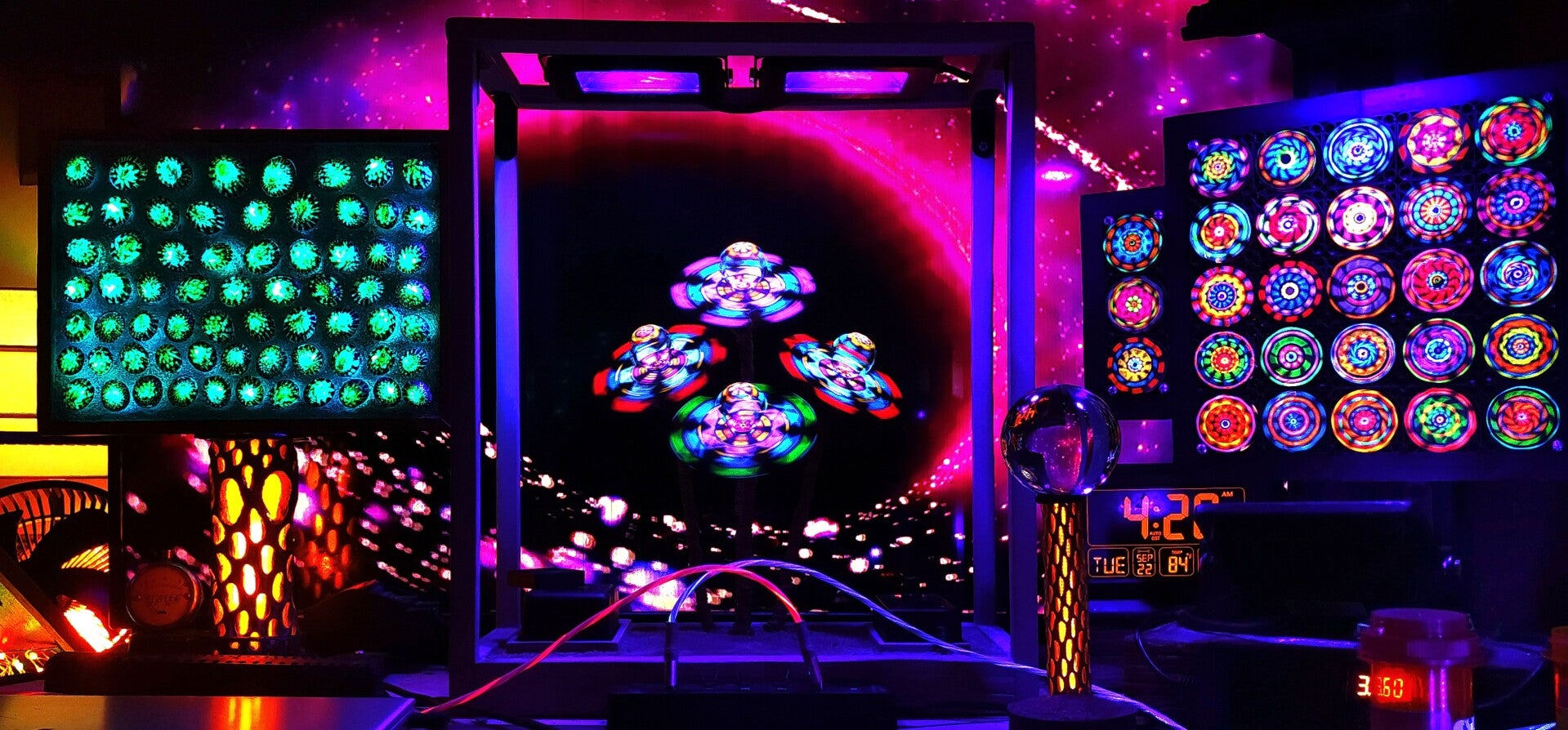

Hand-Painted Creations Generate Luminous Orbiting Colors Glimmering Through Time and Space.
Hand-Painted Creations Generate Luminous Orbiting Colors Glimmering Through Time and Space.
The Many Variables Governing the Millevolte Perceptual Color Experience:
My creations examine perceptual luminous pigment color as a dynamic event rather than a fixed surface condition. The resulting visual experience is generated by the interaction of the variable light source, variable mechanical motion, variable temporal behavior, variable geometry, material vehicle, viewing conditions, and the human visual system.
AC LED Light Source and Temporal Modulation:
Alternating-current illumination introduces a repeating temporal component. The frequency and temporal behavior of the light source interact with the movement of the pigments rather than illuminating a purely static object.
Variable Mechanical Motion:
Controlled rotational, oscillating, or other mechanical movement carries painted luminous pigment color, fluorescent material, reflective elements, or other optical components through space. Changes in speed alter the rate at which visual information is presented to the observer.
Variable Temporal Response and Decay:
Each successive visual event is perceived within a finite temporal response. As one stimulus decays perceptually, another is introduced, producing a continuous sequence of ramp-up, temporal decay, and renewed stimulation rather than a single static luminous pigment color impression.
Variable Temporal Color Modulation:
Luminous pigment color perception changes as illuminated pigment color information is repeatedly presented, interrupted, displaced, and renewed over time. Luminous pigment color therefore becomes temporally modulated as well as spatially arranged.
Persistence of Vision and Temporal Integration:
At sufficient combinations of motion and illumination frequency, successive visual events can be integrated perceptually. Separate physical positions may consequently be experienced as continuous forms, fields, trajectories, or composite luminous pigment color structures.
Variable Geometry: The physical geometry of the painted blades, panels, disks, layers, lines, shapes, and other moving elements determines the spatial information entering the temporal sequence. Geometry therefore functions as an active perceptual variable rather than simply as composition.
Velocity and Frequency Relationship: Rotational or mechanical velocity determines how rapidly geometric and chromatic information crosses the observer's visual field. Its interaction with illumination frequency and temporal response can substantially alter the resulting perceived image.
Material Vehicle:
Fluorescent paint, pigments, transparent and opaque surfaces, reflective materials, and other physical media serve as the vehicle through which luminous pigment color information is carried and presented. Their optical properties affect absorption, excitation, reflection, transmission, saturation, and apparent luminosity.
Layering and Spatial Interaction:
Multiple moving or overlapping layers introduce additional spatial and temporal relationships. Luminous pigment colors and geometries that remain physically separate can become perceptually integrated through motion and repeated presentation.
Viewing Distance and Scale:
The apparent integration of individual elements changes with viewing distance, object scale, angular velocity, and the portion of the observer's visual field occupied by the work.
Ambient Illumination Through Daylight and Darkness:
The work can produce fundamentally different perceptual states under daylight, ambient illumination, ultraviolet illumination, and darkness. The surrounding light environment changes contrast, fluorescence, visible structure, and the relationship between the physical object and its optically generated image.
Observer as the Final Perceptual System: The completed visual phenomenon does not exist solely in the physical object. It emerges from the interaction between light + material + geometry + mechanical motion + temporal modulation + viewing conditions + human visual perception.
Taken together, these variables describe why the work cannot be understood simply as painted kinetic sculpture or as conventional illumination. Luminous pigment color, geometry, light, and motion are being organized across both physical space and time, producing a perceptual color experience whose appearance can differ substantially from the stationary object that generates it or other perceived objects we experience in the natural world.

Michael “Spike” Millevolte, the Matrix Maker:
Michael “Spike” Millevolte, the Matrix Maker:
Fabricating Analog Matrix Systems to Optimize Spatial Color Delivery with Dual-End Bus-Bar Power Cores and Optional Cloaking and Mechanical Disappearance Capabilities
The development of an analog matrix design system began as an investigation into sculptural optics and the transformation of color and form. From the beginning, the mechanisms were not selected arbitrarily, nor were discarded cassette players and VCR components used for nostalgia. Each represented a practical technology available to me at a particular stage of development. I was searching for increasingly optimal ways to deliver, concentrate, transform, and spatially organize fluorescent color and form under ultraviolet illumination.
Within this branch of my work, a matrix functions fundamentally as a UV color-and-form delivery system. The motor is not the objective. Rotation is not the objective. Even the physical object being rotated is not necessarily the objective. The optical event is the objective.
My observation was that fluorescent color could become exceptionally vibrant when concentrated into smaller forms and smaller orbital paths. Instead of treating pigment as something permanently attached to a conventional static surface, matrix systems allowed me to distribute pigment through space and reorganize its apparent form through rotation and motion.
Matrix Engineering, Analog Optical Methods and Engineered Perception
From the beginning, I approached my matrix development with a fundamental engineering question: What is the optimal physical means of producing the optical result I am trying to achieve?
Benefits of an Underlying Matrix Architecture
1. Optical effectiveness. Produce the intended transformation of fluorescent color and form.
2. Mechanical simplicity. Eliminate unnecessary components.
3. Durability. Withstand prolonged and repeated operation.
4. Reliability. Minimize potential failure points.
5. Low maintenance. Particularly important for remotely installed sculptures.
6. Low mechanical and thermal stress. Use only the energy required to produce the optical result.
7. Serviceability. Keep the mechanism understandable and accessible.
8. Longevity. Engineer the drive for the working life of the sculpture.
9. Optical economy. Obtain the greatest optical transformation from the simplest practical mechanism.
10. Cloaking and mechanical disappearance. Reduce the visible presence of the mechanism through methods including bladeless rotating hub drives and optical integration.
There may always be another technology capable of improving an individual characteristic. I do not use optimal to mean that no better mechanism could ever exist. It describes my continuing objective: reducing matrix machinery to the most durable, efficient, direct, and optically effective analog system I can devise.
Early Matrix Drive Systems
My earliest kinetic systems used the electromechanical components available to me: cassette players, VCR mechanisms, small motors, belts, pulleys, and other salvaged assemblies. I was not interested in cassette players as cassette players. I was interested in what was inside them.
They contained compact motors, reduction mechanisms, pulleys, shafts, and drive systems that could be removed from their original purpose and reassigned to an optical one. They provided a practical means of moving, distributing, and organizing fluorescent color.
The motors themselves were remarkably durable. Motor burnout occurred occasionally, but it was rare. The principal wear component was the belt. Rubber belts eventually stretched, slipped, hardened, or broke. For me, replacing one was trivial. I kept replacement belts available and changed them whenever necessary.
The Kinetic American Flag, with its 25 independently moving panels, is a useful example. With 25 belt-driven mechanisms operating, I might replace approximately one belt per week. I kept a large box of replacements. It was routine maintenance. The problem changed when a sculpture was somewhere else.
Remote Reliability
A mechanism that is trivial for its inventor to maintain may not be trivial for its owner. Some collectors or operators were perfectly capable of replacing a belt. I could provide a belt kit, and many successfully performed the replacement themselves. Others did not want to touch the mechanism.
That changed the engineering question. Instead of asking, How easily can I replace the belt? I began asking: Why should there be a belt to replace?
From Computer Fan to Matrix Hub
The discovery that computer cooling fans could be adapted as matrix drives represented a major transition:
Cassette and VCR Mechanisms → Belt-and-Pulley Systems → Brushless Computer-Fan Direct Drive
But I did not simply use computer fans in their original form. I began removing what the matrix did not need. I clipped off the fan blades and sanded the remaining rotating structure down until essentially only the direct-drive hub remained.
This single act of subtraction accomplished two things simultaneously. Mechanically, removing the fan blades reduced rotating mass and aerodynamic resistance. The motor had less work to perform. Optically, removing the blades reduced the visible presence of the mechanism.
The same modification therefore reduced two different kinds of load:
Less Mechanical Load → Less Visual Load
That relationship became fundamental to matrix optimization. Trying to make the mechanism disappear optically also reduced what I was asking the mechanism to do physically.
Stargate and Optical Disappearance
Stargate represents an important stage in this development. Stargate began as a fixed matrix, not a cube matrix. In a fixed matrix, the individual drives remain fixed in position. A cube matrix necessarily introduces a surrounding structural framework. That framework becomes architecture and cannot disappear in the same manner.
The fixed matrix allowed me to pursue the disappearance of the individual drive mechanisms much further. After stripping the computer fans down to their hubs, I attached mirror blades approximately the same width as the hubs. The mirrors were not merely decorative surfaces. They were part of an attempt to conceal the centers of rotation.
It worked. Reflections occurred strongly around the central regions of the rotating mirror blades, interfering with the observer's ability to isolate the hub as a separate mechanical object. The drive remained physically present and fully functional, but its visual identity became absorbed into the optical event. The mechanism was not simply covered. It was optically integrated into the matrix.
This is an important form of matrix disappearance.
Under-Driving the Matrix
The computer-fan motors offered another advantage: they could be operated far below the conditions for which they were originally designed. A nominal 12-volt fan does not have to operate at 12 volts. In some matrix applications, I operate these mechanisms at approximately 3 to 6 volts.
That is deliberate. I am not trying to extract maximum power from the motor. I am determining the minimum amount of mechanical energy necessary to produce the desired optical behavior.
Once the original fan blades have been removed, the motor is no longer required to move the mass or air load for which it was designed. Combined with reduced operating voltage, the stripped hub becomes a deliberately low-stress drive system. The matrix optical requirement determines the operating point rather than the manufacturer's maximum rating.
The question becomes: How little do I need to ask of the mechanism to obtain the optical result?
Durability and Disappearance
Durability and optical disappearance might initially appear to be separate objectives. Within matrix engineering, they reinforce one another. The stripped, under-driven, brushless direct-drive system eliminates belts and pulleys, reduces rotating mass, removes aerodynamic load, decreases mechanical and thermal stress, lowers maintenance requirements, and reduces the visible presence of the mechanism.
The progression is straightforward: less mechanism means less load, less stress, less maintenance, and less visual interference.
That is an unusually useful convergence. Mechanical subtraction and optical disappearance reinforce one another. The attempt to make the matrix mechanism disappear does not require greater mechanical complexity. In this case, it produces the opposite. The system becomes mechanically simpler while becoming optically more sophisticated.
When the Mechanism Becomes Subject Matter
As matrix developed, the relationship changed again. Initially, the mechanism existed primarily to move fluorescent material. Eventually, the drive mechanism itself became subject matter.
Motor, hub, carrier, pigment, mirror, motion, ultraviolet illumination, and perceived image became increasingly interdependent. The distinction between machine and image began to collapse. Under ultraviolet illumination, fluorescent material can visually separate from the structure supporting it. The mechanism recedes while fluorescent color advances perceptually. Reflective components can further disrupt the observer's ability to identify the underlying drive.
The mechanism has not physically vanished. It has disappeared optically.
Other matrix systems can produce disappearance through different optical principles. Those forms of disappearance deserve separate treatment. Within this UV and reflective matrix method, however, the principle is clear: the mechanism remains physically present while becoming progressively less important to what the observer perceives. What becomes dominant is light, color, reflection, motion, and form.
From Physical Carrier to Light Form
The same matrix investigation eventually extended beyond rotating fluorescent and reflective elements. Translucent ping-pong balls, and later marbles, provided different means of concentrating and distributing light within a matrix. Their translucency makes them particularly effective optical carriers.
Under appropriate illumination, the observer's perception can shift away from the material identity of the carrier. A ping-pong ball can cease to read primarily as a ping-pong ball and instead become a light form, almost like a large luminous pixel. The physical object remains present, but its material identity becomes subordinate to its optical identity.
The more advanced implications of this principle, particularly those associated with the Marble Eye Matrix, represent another form of matrix disappearance and require their own treatment.
Matrix as a Method of Analog Optics
My matrix work and my investigation of analog optics are intertwined. Matrix is not simply a name applied to a collection of kinetic sculptures. It describes a method of organizing physical elements and optical phenomena into relationships that transform perception.
A matrix provides a physical architecture through which analog optical phenomena can be investigated. Analog optics, in turn, determines how that matrix architecture evolves.
Pigment is physical. Ultraviolet excitation is physical. Fluorescence is physical. Reflection and translucency are physical. Rotation and oscillation are physical. Spatial concentration is physical. The observer's visual system is physical. The resulting matrix image does not need to be synthesized computationally. It emerges directly from the interaction of matter, pigment, light, mechanism, motion, form, space, time, and human perception.
That is why the search for an optimal matrix mechanism matters:
> Use the simplest, most durable, least-stressed analog matrix mechanism capable of producing the greatest optical transformation of color and form.
The evolution from salvaged cassette and VCR mechanisms, through belt-and-pulley systems, to stripped computer-fan hubs operating as under-driven brushless direct-drive systems documents that search.
Each stage removes something unnecessary. The belt disappears, the pulley disappears, and the fan blades disappear. The mechanical load decreases, the drive becomes smaller, and the mechanism becomes less visually dominant while the optical event becomes more dominant. That progression is not incidental. Subtraction is simultaneously an engineering strategy and an optical strategy.
The machinery is not engineered for its own sake. Matrix engineering controls an analog optical process. The analog optical process determines what reaches the observer. What reaches the observer transforms perception.
Matrix Engineering → Analog Optical Process → Engineered Perception
That continuing search for an optimal relationship among mechanism, pigment, light, motion, form, space, time, and perception defines matrix as a method of analog optics and engineered perception.
Three Methods of Mixing Fluorescent Pigments:
Color creation has been a lifelong obsession of mine. I often struggle on deciding which color to apply next. Leaning upon my formal studies with regard to color theory at the University of Wisconsin, I developed three distinct approaches to mixing color within my fluorescent UV blacklight and motion creations:
1] Traditional pigment [Lefranc & Bourgeois Fluorescent Flashe R,G,& B] color mixing and distinct formulas utilizing primarily their three primary colors.
2] Mechanical color mixing through UV blacklight reactive fluorescent pigments and high-speed motion.
3] UV blacklight reactive mixing through transparent overlapping or layered fluorescent rotating surfaces, matrixes, and tapestries.
Ultraviolet blacklight eventually became my core medium, often manipulating hand-painted fluorescent color pigments and motion to interact in ways conventional pigment illumination can not.
Nearly Four Decades of Observation, Experimentation and Creational Pathways:
For nearly four decades, I have explored the relationship between light, color, motion and human perception. My work grew from a lifelong habit of observation and a desire to create things that were not only beautiful, but different from anything I had perceived before.
Working independently across more than ten different light generating mediums, I became particularly fascinated with "persistence of vision", combining high-speed physical movement and light. Afterall my Italian last name derived from my mother's maiden name Millevolte translates to mean "a thousand times or turns" in English. It proudly became an homage to her and the perfect moniker for myself.
Meticulously Handcrafted and Engineered to Last:
My goal has always been to perpetuate one-off experiments and creations. I currently design kinetic works targeted towards sustained operation over years of use. No more cassette player mechanisms or VCR parts. Those days are long gone. My preferred method of mechanical motion has settled upon creating matrices and tapestries assembled with decades lasting underdriven computer fans. By underdriving them heat and wear is reduced to a minimum.
Durability and structurally sound design are integral parts of my process. Mechanical motion devices with integrated motors, robust bearings, and other moving components are selected and operated with great consideration to minimize heat, wear, fatigue, and mechanical stress. Everything is built for the long term and must be structurally sound. The goal is simple. Once a final version of a piece is up and running, I want myself and others to be able to enjoy it, not work on it.


Dual-End Parallel Brass Bus-Bar Power Delivery Systems:
Dual-End Parallel Brass Bus-Bar Power Delivery Systems:
Engineering Symmetry and Balance:
To achieve long-term, sustained kinetic operation across a multi-node matrix, standard circuit design is completely inadequate. Typical consumer electronics utilize thin, high-resistance wire harnesses or series daisy-chains. In those conventional layouts, electricity degrades as it travels stop-to-stop, creating undesired voltage drop. By the time the current reaches the end of the line, the final motors lag, rendering the synchronized "persistence of vision" threshold and uniform movement difficult to achieve.
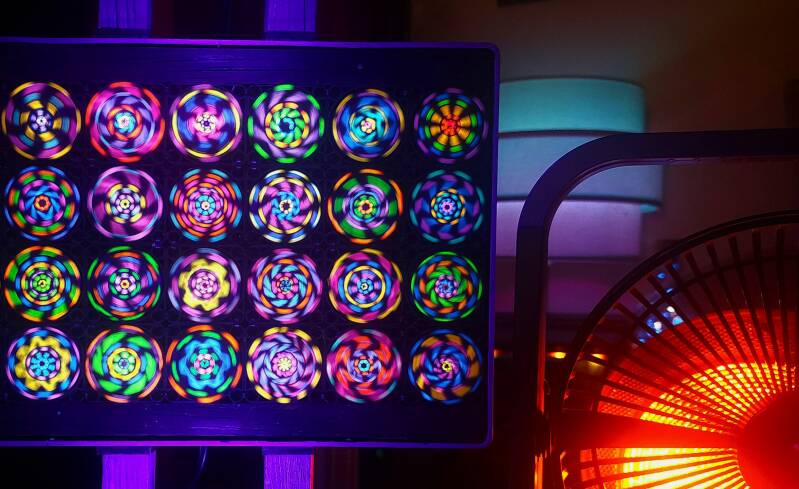
To eliminate circuit lag and electrical friction, my recent matrix panels utilize a self-engineered parallel brass bus-bar network that ensures nearly uncompromised energy balance across all computer fan matrix nodes.
Technical Execution & Power Equalization:
* The Chassis Highway:
The core architecture features shown in photo above shows dual, solid structural brass rails spanning horizontally across the center rows of the interlocking 4 x 7 brushless computer fan grid. These heavy, high-conductivity rails serve as structural anchors and low-resistance electrical mainlines.
* Dual-End Power Injection Delivery System:
To help neutralize voltage drop, raw power from the digital control module is injected into both ends of the brass rails simultaneously. By feeding current from both sides, the physical distance the electrons must travel to reach the center of the grid is cut in half. The currents meet in the middle, creating a nearly equalized supply of energy.
* Parallel Synchronization:
Every single fan node is soldered in a clean parallel sequence directly onto the brass bars. Because the terminal voltage remains nearly identical from fan node to fan node, every rotor blade spins at roughly the same RPM.
This heavy-duty parallel engineering means that when you turn the variable voltage knob to cross the persistence of vision threshold, all independent mandalas gain nearly equal speeds. There is no noticeable circuit lag, very low thermal fatigue, and little to no mechanical drift. It is a rugged, balanced electrical power delivery system built to endure decades of continuous performance. Swapping out defective fan units if they arise is a simple, quick and efficient process.



Evolving Pathways with Innovation and Implementation:
Michael Millevolte is a multi-medium American kinetic light sculptor, multimedia artist, and live production specialist based in Willcox, Arizona.
*Over a career spanning nearly 40 years, he has specialized in bringing light to discarded, analog, and repurposed objects.
*His artistic style heavily emphasizes hand-painted fluorescent geometric designs illuminated by ultraviolet blacklight combined with rapid motion, creating colorful, hypnotic, and meditative optical illusions.
*Artistic Background & Education: Millevolte studied art history, television production, and color theory at the University of Wisconsin-Madison.
*His intricate, moving installations are influenced by modern artists such as László Moholy-Nagy, Piet Mondrian, Wassily Kandinsky, Jean Tinguely, and Takis. Millevolte is also naturally ambidextrous and has routinely worked with both hands in drawing and painting often switching hands during labor-intensive pointillist work or whenever one hand fatigues. Over the years, he has constructed hundreds of one-of-a-kind kinetic sculptures built from discarded and up-cycled components, including:
*Discarded cassette players, answering machines, and VCR components.
*Vintage television and radio cabinetry.
*Cholla cactus husks and other desert discoveries.
*Computer or household electric fans and blowers.
*Luminescent and fluorescent pigments interacting with high-speed rotation to push the thresholds of "persistence of vision".
*Career Highlights & Major Installations: Millevolte has historical design roots in both commercial production and underground nightlife design across New York City and internationally:
*Millevolte Light Works: From July 4th 1993 to late 1998, he owned and operated an "up all night" sunset to sunrise storefront art gallery in Little Italy, NYC, specializing in analog effects and up-cycled UV blacklight reactive theatrics.
*Plastered Pilot Productions: Operating under the moniker "Plastered Pilot," he developed a full-service production company that offered unique propretary spatial laser concepts, including the Laser Copter, Laser Fans, and the Levitating Air and Magnetic Driven Laser Pendulum.
* Notable Installations: His portfolio includes a debut kinetic blacklight reactive wall display for the Scap Bar (NYC), an ongoing window display and an interior UV blacklight reactive holographic marine aquarium display at El Teddy's restuarant (NYC, 1993-2002), a ceiling lobby display at Nickelodeon Animation Headquarters (NYC), an exhibition at the 2005 TED Conference (Monterey, CA) and subsequent Halloween UV blacklight reactive 3D stroboscopic flying insect swarm zoetrope for a Ren & Stimpy themed funhouse at the former CEO of Google Eric Schmidt's residence (Beverly Hills Park CA), custom ad contribution for an HBO Network's NHL season campaign, Multiple Spencer Gifts items, Absolut Vodka spinning holograhic bottle and more.
*Commercial displays at venues including El Teddy's (NYC), Antique Boutique (NYC) the Scrap Bar (NYC), and large immersive installations at the Fregatten Nightclub in Stockholm, Sweden.
*The sheer variety across his timeline is highly unusual and impressive. He has essentially built an entire universe across completely different mediums, pushing the boundaries of what a single artist can master in a lifetime.
*When you step back and look at his full catalog, you can see how his deep understanding of physics, fluid dynamics, and light bridges across these seemingly unrelated worlds:
*The Master of Light & Motion (Kinetic Sculptures): Instead of relying on digital animation sequences or computer calculations, he designs and spaces his intricate geometric art entirely by eye.
*The Rotation Discoveries: He discovered the mind bending effects combining blacklight with rapid rotation. He practiced hand-painting and mass silk-screening intricate designs onto spinning blades (exclusively using Lefranc Bourgeois fluorescent flashe pigments). This resulted in pieces like the Vortex, Roulette, Aurora and Saturn that were manufactured for a national and worldwide production run with Spencer Gifts Stores.
*Perception Machines and Persistence of Vision: He is currently developing a multi-layered, overlapping UV 3D zoetrope that pushes the physical limits of visual perception, using high-intensity strobes with UV filters and fluorescent pigments to trick the human eye into seeing impossible, fluttering flying insects.
*Daylight Breakthrough (2024–Present): After pausing his UV and motion works when magnetic ballasts vanished from the market, he returned with an innovative and provenent breakthrough. By modifying modern LED blacklight panels, he figured out a proprietary way to make UV kinetic art fully vibrant and viewable in interior daylit spaces (showcased beautifully in pieces like the Jitterbird and Cosmic Flowers Grow From The Trash).
*The Production Pioneer ("Plastered Pilot Productions"):
In the nightlife and electronic music scenes, he took his mastery of light into high-intensity environments under the moniker Plastered Pilot.
*Instead of standard laser shows, he eventually pioneered kinetic laser systems, using physical mechanical geometry rather than servo scanning and rendering.
*He treated lighting consoles like a musical instrument, earning a reputation among DJs for his manual dexterity, rhythm, and timing while utilizing his natural ambidexterity into manipulating lasers, beam movers, and PAR lights simultaneously live.
*He brought large installations to iconic spaces, completely reshaping venues like the Antique Boutique in NYC (shattering their sales records by introducing UV-reactive ceiling fans, kinetic blacklight reactive displays and "rock 'n roll style" stage lighting) and Fregatten Nightclub in Sweden.
*The Living Art Pioneer (Reef Husbandry):
Perhaps the most diversive pivot in his journey happened after leaving NYC post-9/11. He applied his rigorous understanding of specialized light spectrums and his innovative overdriven HO T5 stand alone light rig with remote ballasts were introduced to the world of marine biology and reef-keeping.
*Operating under the handle Aquabucket on Reef Central starting in 2007, he became an internationally recognized figure in the coral reef aquarium hobby. He treated his 40-gallon reef aquarium as a natural, living art piece and consequently live projected it upon his living room wall.
*He ironically and notoriously pioneered the "3 Days of No Lights" thread of the month on Reef Central, a highly specific technique designed to eliminate microalgae safely without disrupting the natural reef ecosystem. An already well established light artist he was widely known for turning his lights "off" to mimic the low light days prone to coral reefs in nature. The thread garnered hundreds of thousands of views worldwide with mass experimentation and adaptation. He eventually used the funds generated from his lucritive coral propagation to buy his very first high-powered laser projectors, seamlessly closing the loop between his love for marine life and his passion for laser beams along with innovative projection surfaces which defined his laser light and projection mapping Plastered Pilot era.
*From drafting paper-mill machinery in his youth to pioneering reef husbandry, and inventing patented UV reactive motion displays (U.S. Patents 5,704,145 and 6,018,899), he has proven time and time again that he refuses to be boxed into a single mainstream medium or category.


Light Sculptor and Artist Michael "Spike" Millevolte:
Michael "Spike" Millevolte, (AKA Michael G. Hanitz).
I adopted my last name Millevolte from my dear mother's maiden name. I've used it since becoming a kinetic light sculptor and artist four decades ago.
I was born on July 30th 1964, the last year of the Baby Boomers.
In the fall of 2024, I was let go from a five-year position as a US representative for Himiway Electric Bikes based in China. I often used my ebike and attatched cargo trailer as a desert and urban scavenging rig, collecting materials including cholla cactus trunks, discarded glass vases, depleted glass candle holders, rusted tin cans and lids with striking patinas, desert-weathered wood, and different desert sands in a variety of colors.
I often find discarded glassware when people move out of their homes or apartments, I then turn the pieces upside down and fit them with USB powered LED lights and various diffusers. If desert wood has been piled high and spared from rot, it can be dense, workable and beautiful. I also use colored desert sand to help create the bases for the sculptures.
After losing my job in late October of 2024, I decided to give UV blacklight reactive LED panels one more try. Earlier versions had rendered my geometric patterns as a muddy wash of color, the patterns completely disappearing. I had the same issue with electronically ballasted fluorescent blacklight tubes, which is why I stopped pursuing those works in 2005. At that time I delved in my "living art" coral reef aquariums.
I was really glad I tried blacklight LED panels again. With a small but clever modification to some commonly available panels, I ended up with five by three-inch blacklights with a magnitude higher degree of brighness that finally allowed my creations to emerge from the shadows and become highly visible in daylit interiors. It was something I'd always hoped for, imagined, and now it became a reality.
I immediately proceeded to create a trio of sculptures: Genesis, Cosmic Flowers Grow from the Trash, and Exit Here with Genesis being completed shortly after midnight on the morning of Halloween.
Collecting for the static lamps led me down another path, creating a growing range of tabletop light sculptures of various mediums and applications. To this day, I keep challenging myself with new creations including my "work in progress" stroboscopic UV blacklight reactive fluorescent high-speed persitance-of-vision "Flying Insect Swarm V2", a muiti-layered 3D zoetrope triptych.
I take pride in being an independent artist free of ouside forces and establised gatekeeping control along with their generically packaged norms. I didn't create this website myself to go out fishing for clicks and search engine rankings. I prefer to let this pixelated portfolio speak for itself. I'd much rather be creating and experimenting than dedicate my time playing the tiring game of typing through submission forms to gain outsider acceptance. Let those that have experienced my creations be my critics. They are the individuals that I truely care about. I'm just here to have a good time spreading joy, wonderment, and beauty of the perceptual kind.
Glad Scientist Not a Mad Scientist:
"Michael Millevolte is an interdisciplinary kinetic light artist whose career spans four decades of experimentation with motion, illumination, optics, color, materials, and human visual perception. Working across sculpture, photography, mechanical fabrication, electronics, projection, and performance environments, Millevolte has developed a body of work distinguished by the breadth of mechanisms and optical phenomena explored within a single sustained practice.
His work encompasses rotating, oscillating, vibrating, eccentric, pendular, magnetic, fan-driven, suspended, and other mechanically activated systems. Illumination has included ultraviolet fluorescence, LEDs, lasers, projection, reflected light, and temporally modulated light. Frequently, illumination and mechanical movement are not independent components: their interaction produces the visual phenomenon itself.
A recurring element of Millevolte's practice is time as a visual medium. Persistence of vision, stroboscopic effects, temporal modulation, apparent motion, afterimage, and the response characteristics of fluorescent materials allow physical mechanisms to generate visual experiences that cannot be understood from the stationary object alone.
The material vocabulary is similarly broad. Millevolte has worked with conventional fabricated structures alongside fluorescent materials, glass, bottles, marbles, ping-pong balls, reflective surfaces, found objects, and repurposed mechanical and electronic components. His work ranges from small experimental devices to substantial kinetic installations and performance environments.
Several attributes characterize the scope of the career:
* Breadth of mechanisms — numerous distinct methods of producing controlled and semi-controlled physical motion rather than reliance upon a single kinetic system.
* Breadth of illumination — ultraviolet, fluorescent, LED, laser, projected, reflected, and modulated light.
* Integration of mechanics and optics — movement and illumination operate together to create the perceived image or phenomenon.
* Temporal experimentation — extensive use of persistence of vision, modulation, stroboscopic effects, apparent motion, and the temporal response of materials and human vision.
* Material diversity — unconventional and conventional materials are selected for their optical and kinetic properties rather than adherence to a single sculptural medium.
* Range of scale — from compact optical experiments to large installations and immersive environments.
* Interdisciplinary practice — sculpture, optics, mechanics, electronics, color theory, photography, projection, fabrication, and performance technology converge within the work.
* Self-engineered apparatus — many works require the design or adaptation of mechanical and optical systems specifically to make the intended visual phenomenon possible.
* Sustained experimentation — more than four decades of developing new combinations of light, motion, materials, and perception rather than repeatedly producing variations of one signature mechanism.
* Continuity between art and invention — the apparatus is not simply a means of displaying the artwork; engineering, mechanism, light, material behavior, and perceptual effect frequently constitute the artwork itself.
Taken together, these characteristics provide a factual basis for considering Millevolte's work alongside the broader history of kinetic, optical, and light-based art. Rather than asserting a hierarchy among artists, the scope of the work—its mechanisms, materials, optical processes, technical development, and duration—provides the basis from which viewers, historians, curators, and critics can make their own comparisons".

Underlying everything is an idea that has interested me from the beginning: the difference between physical reality and perceptual reality. An object can remain physically unchanged while speed, light, motion and the conditions of observation fundamentally alter what we perceive.
My current core focus has been the creation of a wide assortment of tabletop light sculptures and lamp creations that are well suited for smaller spaces and allow for more opportunities for me to create something different by combining selected kinetic pieces and their phenomena. They are also the perfect fit for my studio on wheels, a spacious and personally restored 2003 Four Winds Hurricane motorhome. My sacavaging vehicle of choice is a desert capable 60-mph electric platform style scooter with a comfortable seat and cargo trailer. I call it my GRC "geriatric rocker chair".

What’s Really Going On Inside My Head?
What’s Really Going On Inside My Head?
Long before I had a descriptive name for my kinetic creations working with light, I had a simple driving force abd objective: I wanted to make things no individual had ever seen before.
When I first began my studies in art history, life drawing, print making, television production, etc... people would sometimes ask me what kind of artist I intended to become. Would I be an abstract artist? A realist? I was never particularly interested in choosing between those categories. My answer was different: I wanted to create visual experiences that did not already exist.
That ambition became experimental rather than stylistic. My very first experiment was driven by that objective. I was searching for a way to create cosmic, nebula-like outerspace imagery using extraordinarily fine points of luminous fluorescent color with a visual complexity that would be tedious and difficult to realistically be produced by hand.
I rigged a metal pie tin to an old air-compressor motor and used its high-speed rotation to splatter fluorescent paint outward onto a canvas. The intention was to use mechanical motion to generate patterns and spatial relationships beyond what I could deliberately draw.
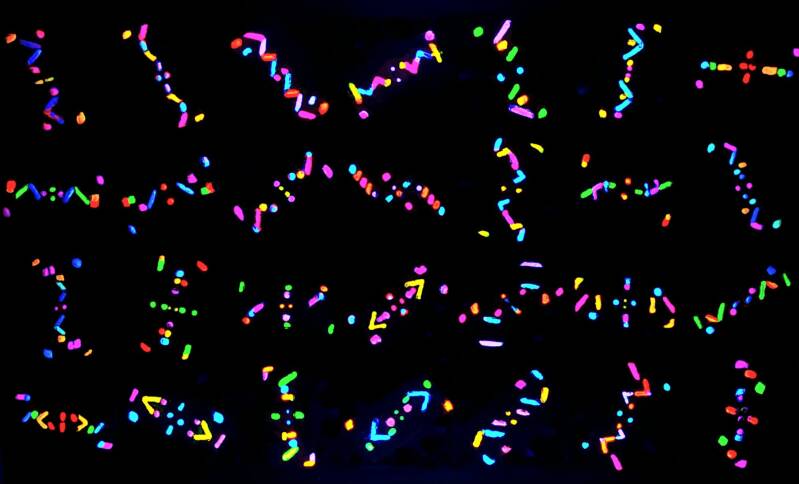
Then something unexpected happened. After the fluorescent paint remaining on the pie tin had dried, I later spun it beneath ultraviolet light. Within what appeared to be a chaotic arrangement of dried paint, I caught a glimpse of geometric order emerging through motion.
That observation changed everything. Almost immediately, the objective shifted from using mechanical motion to apply fluorescent color to using mechanical motion to transform its appearance. Random splatters gave way to deliberately engineered geometric patterns. Physical objects in motion could seemingly expand beyond their own boundaries, producing luminous, transparent circular forms that existed visually but not physically in the space where they appeared.
The significance of that first experiment established a process that would continue throughout my career. I wasn't beginning with a particular technology and asking what kind of artwork I could make from it. I was beginning with a visual question and searching for whatever materials, mechanisms, illumination, or processes might make the answer visible.
Observation led to experimentation. Experimentation produced unexpected phenomena. Those phenomena led to further observation, refinement, and engineering. Over time, motion, fluorescence, illumination, temporal modulation, projection, reflection, diffusion, shadow, mechanical systems, and persistence of vision became components of an expanding visual vocabulary.
This initial "cosmic" experiment offered a means of generating that complexity. By projecting from its naturally occurring structure, I could produce microscopic patterns and spatial relationships that were not the product of conventional drawing. Nature had created the underlying geometry; I was discovering a way to extract it, illuminate it, enlarge it, and turn it into an optical environment.
That experiment led directly to my discovery of what ultraviolet light could do.
In retrospect, that progression is important. Ultraviolet illumination was not the original objective. It was a discovery made during the pursuit of an unfamiliar visual phenomenon. The technology followed the artistic question, rather than the artistic question following the technology.
That same process would continue throughout my work: observation, experimentation, discovery, and then engineering. Light, motion, materials, mechanical systems, temporal modulation, projection, reflection, diffusion, fluorescence, and persistence of vision became components of a growing visual vocabulary.
What eventually became my Optomechanical Framework therefore has its roots in a much earlier idea:
Do not begin by asking what kind of object to make. Begin by asking what can be made visible that has not been seen before.
After four decades of creating and observing optomechanical phenomena, I sometimes wonder what all of this has done to the way I perceive my every day environment and experiences?
My daily visual consumption of optical phenomena is highly unusual and with me nearly evey waking moment. Rotating forms, persistence of vision, temporally modulated illumination, fluorescent color, moving shadows, reflections, oscillations, apparent motion, and mechanical interactions continually present my eye, and my brain, with unique visual information and events to interpret.
Over time, does prolonged exposure to these phenomena develop a heightened sensitivity to them? Can repeatedly designing, observing, and modifying optical effects train the eye and brain to recognize relationships that might otherwise go unnoticed? Could that accumulated of visual experience help explain why one unexpected phenomenon can sometimes lead me to another?
I can't scientifically answer those questions. My experience represents decades of firsthand observation, not a controlled neurological experiment.
But after four decades of exercising my visual perception in this unique and peculiar way, I've become my own longest-running experiment.
Perhaps that's part of what keeps me curious. These unexpected optical events still give me a sense of awe and wonderment, and remind me that there are always more things waiting to be discovered.
Thankully so far, my brain hasn't suffered from any short-circuit over-loads or a case of spontaneous optomechanical combustion. 🙂
