Magnetic and Air-Driven Laser Pendulum. Kinetic Luminous Calligraphy Through Spatial and Temporal Motion, Michael Millevolte. 2026
1.] Introduction: An Optomechanical Investigation of Motion, Light, and Space:
The Magnetic and Air-Driven Laser Pendulum is an optomechanical kinetic sculpture that transforms the physical movement of a suspended laser assembly into continuously changing luminous trajectories. Originating in Millevolte's Plastered Pilot investigations of 2013, the apparatus combines aerodynamic excitation, magnetic interaction, and projected laser illumination to generate evolving compositions of light and motion.
Unlike conventional laser projection systems employing motor-driven mirrors or electronically programmed scanning patterns, the Magnetic and Air-Driven Laser Pendulum derives its visual compositions from the physical movement of the light-emitting assembly itself.
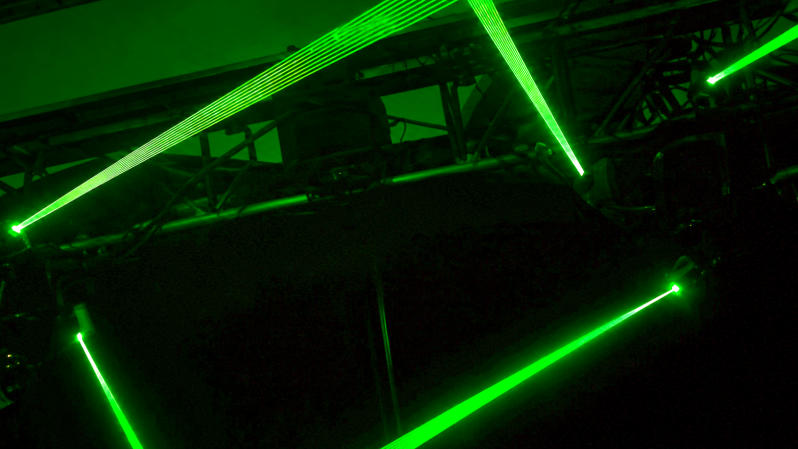
Four laser diodes mounted to the suspended apparatus project beams into the surrounding environment. As the assembly moves, their trajectories produce changing geometric and calligraphic compositions across walls, ceilings, and other receiving surfaces.
The system accommodates both indoor and outdoor embodiments. Indoor configurations may employ mechanically generated airflow, while outdoor installations may utilize natural wind. In either configuration, individually positioned magnetic elements influence the suspended assembly's movement.
The resulting optical experience is governed by the interaction of airflow, magnetic forces, gravitational restoring forces, pendular motion, beam orientation, projection distance, and the spatial arrangement of receiving surfaces.
The fundamental artistic principle is the transformation of comparatively small mechanical movements into expansive luminous motion.
2.] Mechanical Suspension, Aerodynamic Excitation, and Magnetic Operating Principles:
The apparatus consists of a suspended laser assembly supported by a flexible tether. Electrical conductors supplying the laser diodes are arranged around the supporting tether without assuming the primary structural load.
The suspension permits the assembly to move through a range of pendular and orbital trajectories. Aerodynamic forces supply mechanical excitation, while individually positioned magnetic elements influence the direction, amplitude, and character of the resulting movement.
A.) Suspended Laser Assembly: A flexible supporting tether carries the weight of the apparatus while permitting angular displacement, oscillation, and orbital movement.
B.) Four Laser Diodes: Multiple light sources project distinct trajectories into the surrounding environment. Their individual orientations determine the angular relationships between the projected beams.
C.) Natural Wind — Outdoor Embodiments: Ambient airflow supplies aerodynamic forces that may initiate and sustain pendular movement. Changes in wind direction, velocity, and turbulence introduce naturally varying mechanical excitation.
D.) Forced Air — Indoor Embodiments: Fans or other controlled airflow sources provide adjustable aerodynamic excitation. Airflow direction, velocity, and distribution may be modified to investigate different oscillatory responses.
E.) Magnetic Interaction: Individually positioned magnetic elements influence the movement of the suspended assembly through attraction, repulsion, or combinations of both, depending upon the magnetic materials and polarity arrangements employed.
F.) Combined Aerodynamic and Magnetic Forces: Airflow supplies mechanical energy to the moving assembly, while magnetic interactions alter its potential-energy landscape and influence its resulting trajectories.
G.) Electrical and Structural Separation: The supporting tether carries the mechanical load, while electrical conductors supply the laser diodes. Their arrangement must preserve freedom of movement without excessive twisting or interference.
The apparatus is mechanically suspended rather than magnetically levitated. Magnetic interaction influences the motion but does not replace the supporting tether.
Stationary permanent magnets do not continuously supply the energy required to overcome mechanical damping. Sustained movement depends upon aerodynamic excitation or another external energy source.
3.] Individual Magnetic Placement and Spatial Arrangement:
The individual positioning of magnetic elements introduces a variable system for influencing the pendulum's mechanical behavior and its resulting projected optical trajectories.
Rather than relying upon a single predetermined oscillation, the sculpture permits experimentation with the spatial distribution of magnetic forces.
Each magnet represents an independently adjustable mechanical variable.
A.) Individual Magnet Position: Changing the location of a magnetic element alters the direction and magnitude of its influence upon the suspended assembly.
B.) Magnetic Polarity: The relative orientation of magnetic poles determines whether particular interactions are attractive or repulsive.
C.) Magnetic Spacing: The separation between magnetic elements and the moving assembly influences the strength and spatial distribution of the magnetic forces.
D.) Vertical Placement: Positioning magnets at different heights changes their relationship to the suspended assembly throughout its trajectory.
E.) Angular Arrangement: Asymmetrical magnetic placement can introduce directional preferences and alter the character of the resulting motion.
F.) Magnetic Field Strength: Different magnetic strengths may produce different responses, depending upon the mass, magnetic properties, and suspension characteristics of the moving assembly.
G.) Combined Magnetic Fields: The simultaneous influence of multiple magnets creates a composite force field that may produce trajectories substantially different from those generated by any individual magnet.
H.) Dynamic Adjustment: Repositioning individual magnets provides a method of experimentally modifying the motion without changing the underlying suspended laser assembly.
The resulting trajectories depend upon the combined magnetic force field, gravitational restoring forces, aerodynamic excitation, mechanical damping, and the initial motion of the pendulum.
Magnetic placement can influence acceleration, displacement, and trajectory. The resulting optical behavior is therefore adjustable through the spatial arrangement of the magnetic elements.
4.] Optical Velocity Through Spatial Arrangement:
The Magnetic and Air-Driven Laser Pendulum introduces a relationship between the physical velocity of a suspended light source and the apparent velocity of its projected luminous trajectories.
The mechanical movement of the laser assembly may be relatively small compared with the movement of the projected laser spot across a distant surface.
As the pendulum changes orientation, its projected beams sweep through space. The apparent speed of their intersection with receiving surfaces depends upon angular velocity, projection distance, and surface orientation.
A.) Angular Motion: The pendulum's changing orientation determines the direction and angular velocity of each projected laser beam.
B.) Projection Distance: Greater distances between the laser assembly and receiving surfaces can produce larger projected displacements for the same angular movement.
C.) Surface Orientation: Angled or irregular receiving surfaces modify the relationship between beam direction and the apparent trajectory of the illuminated point.
D.) Spatial Multiplication: Multiple laser diodes produce several related trajectories from the movement of a single suspended assembly.
E.) Variable Optical Velocity: The apparent velocity of projected light can change substantially across different receiving surfaces, even when the mechanical movement of the laser assembly remains comparatively consistent.
F.) Architectural Scale: Walls, ceilings, and other architectural surfaces provide opportunities for translating compact mechanical motion into large-scale luminous compositions.
For a simplified configuration involving a beam directed toward a perpendicular plane, projected displacement may be expressed as:
x = L tan θ
Where L represents projection distance and θ represents the beam's angular displacement relative to the plane's normal.
The corresponding projected velocity is:
dx/dt = L sec²θ · dθ/dt
This relationship demonstrates how projection distance and angular orientation influence the velocity of the illuminated point.
It also establishes a distinction between the physical motion of the apparatus and the apparent motion of its projected image.
The pendulum supplies the mechanical movement; spatial arrangement determines how that movement is translated into optical velocity.
5.] Multiple Laser Diodes and Compound Optical Trajectories:
The four laser diodes introduce an additional level of visual complexity.
Although all four sources participate in the motion of the suspended assembly, their individual beam orientations may differ.
Consequently, each diode can produce a distinct projected trajectory.
A.) Parallel Beam Configurations: Similarly oriented beams may produce related luminous movements across receiving surfaces.
B.) Divergent Beam Configurations: Differently angled beams may distribute luminous trajectories across separate architectural regions.
C.) Intersecting Trajectories: Projected paths may cross or overlap, producing compound visual compositions.
D.) Variable Projection Distances: Beams reaching surfaces at different distances may exhibit different apparent speeds and displacement ranges.
E.) Spatially Distributed Composition: Multiple receiving surfaces permit the sculpture to operate across a three-dimensional architectural environment rather than a single projection plane.
The resulting composition is generated through the relationship between the mechanical trajectory of the pendulum and the individual orientations of its laser diodes.
The sculpture therefore employs a single moving assembly to generate multiple related but visually distinct luminous trajectories.
6.] Laser Beam Interactions and Capture:
The Magnetic and Air-Driven Laser Pendulum is not restricted to projecting light onto conventional walls or ceilings.
Its optical behavior may be expanded through the introduction of receiving surfaces that intercept, transform, diffuse, reflect, or temporarily retain the moving laser illumination.
These configurations establish several distinct methods of beam interaction.
A.) Uninterrupted Projection — Luminous Calligraphy:
In its simplest configuration, the apparatus projects freely moving laser trajectories across surrounding walls, ceilings, or other designated receiving surfaces.
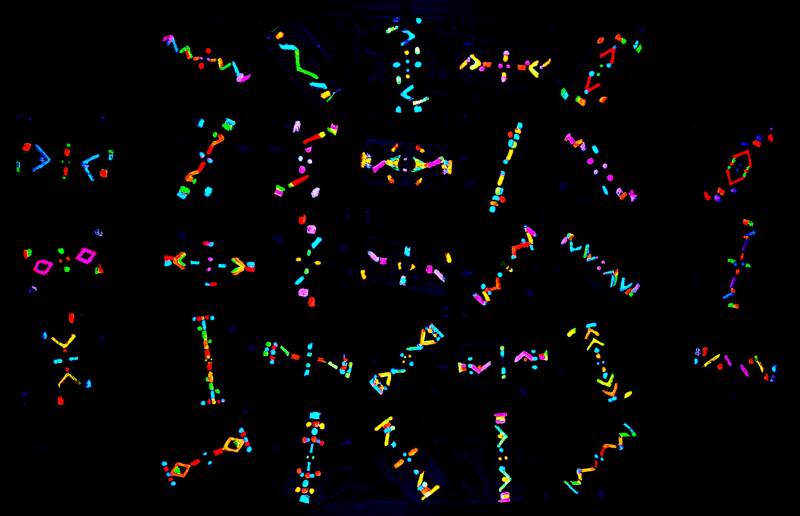
The moving points of illumination trace continuously changing paths, producing an experience resembling luminous handwriting or calligraphic drawing.
These compositions emerge directly from the movement of the suspended laser assembly.
No intermediate optical capture panels are required.
The resulting trajectories may include sweeping arcs, loops, overlapping curves, and irregular geometric formations.
The term luminous calligraphy describes the artistic appearance of these moving trajectories rather than implying that the beams necessarily leave persistent marks.
B.) Variable Beam Capture:
Additional optical effects may be introduced by positioning selected materials within the projected beam trajectories.
Receiving surfaces can be arranged at different distances, heights, and angles.
Their optical characteristics influence the resulting appearance of the intercepted light.
Types of Beam Capture Surfaces:
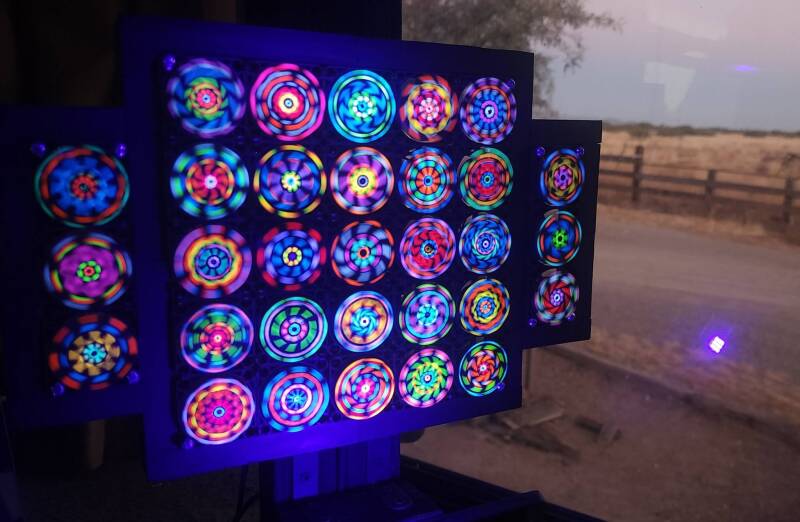
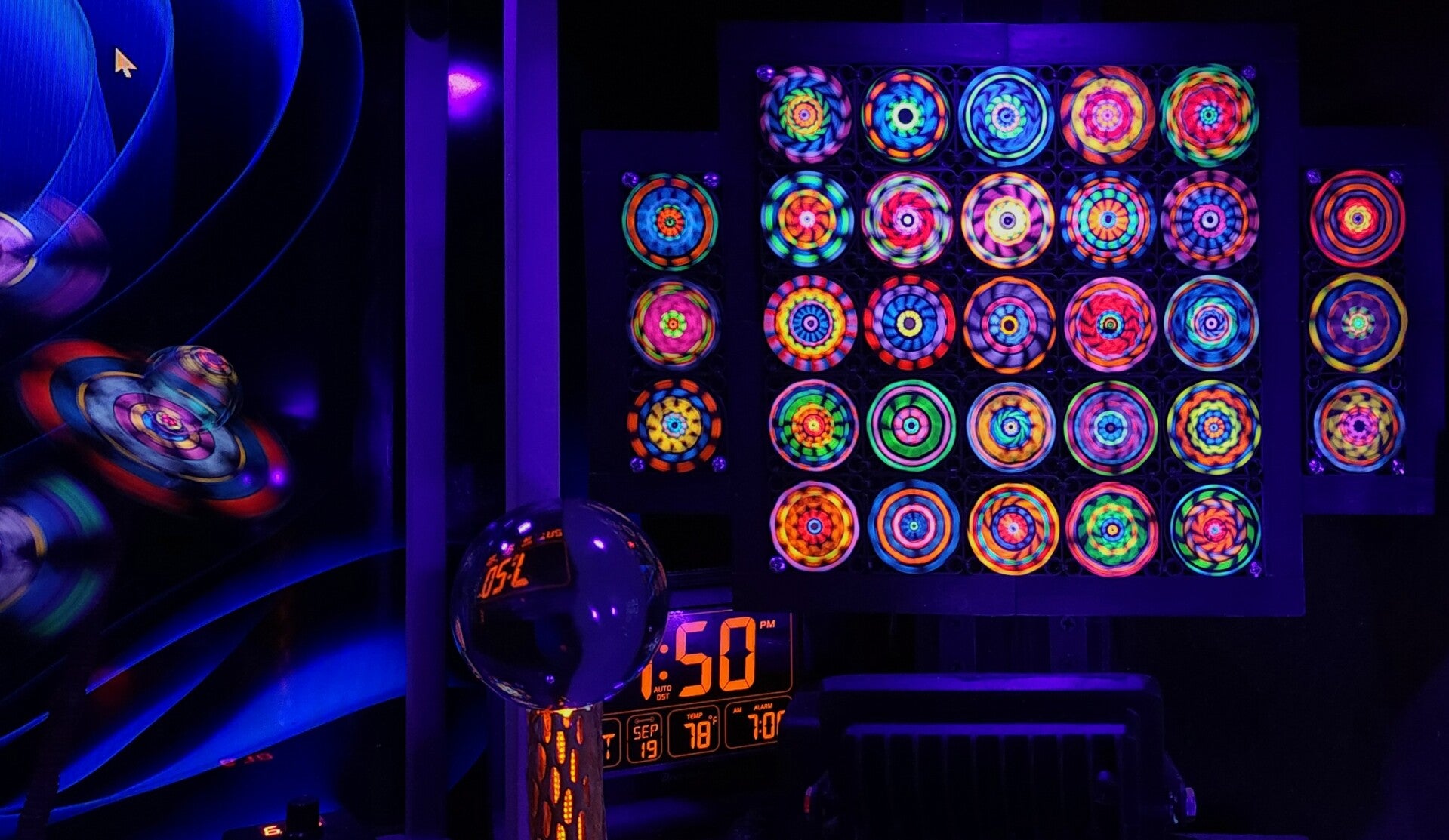
1.] Photoluminescent Panels: Materials capable of absorbing incident illumination and subsequently emitting visible light may produce temporary luminous traces. Appropriate excitation wavelengths and sufficient optical exposure are required to obtain the intended afterglow.
2.] Reflective Surfaces and Mirrors: Reflective materials redirect incident light and may introduce additional projected trajectories. Their orientation determines the direction of the reflected beam. Mirror configurations require particular attention to beam containment and eye safety.
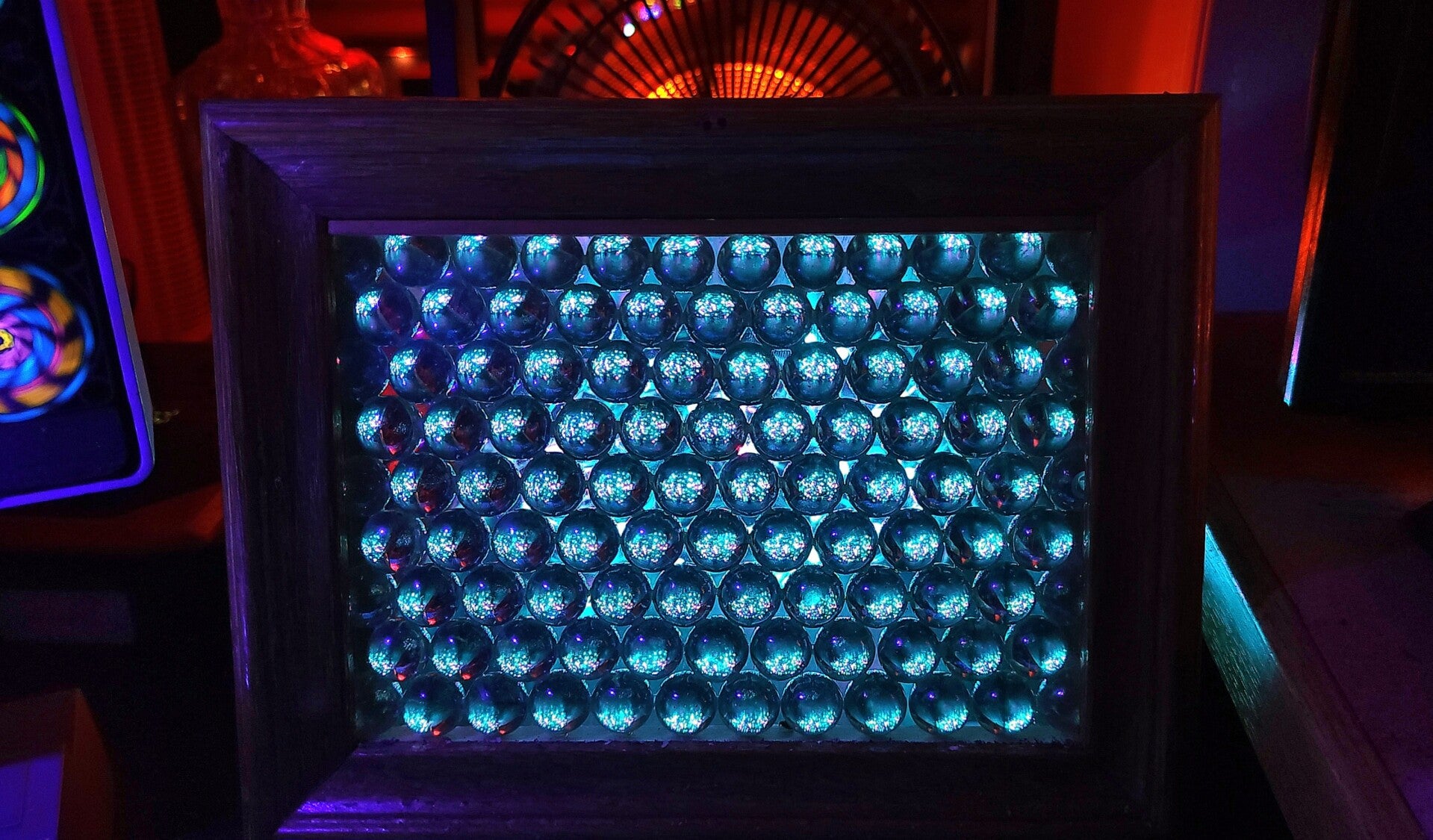
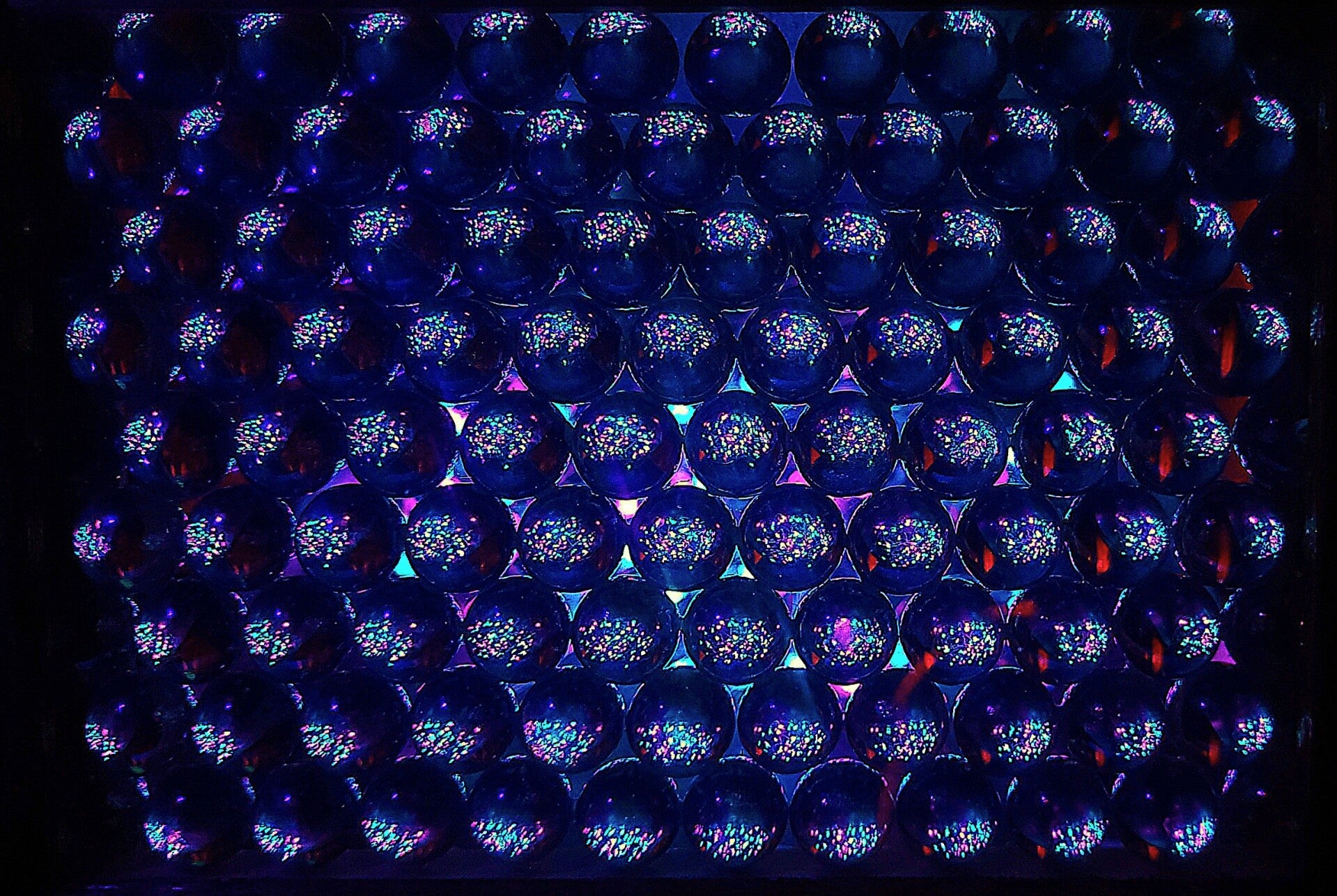
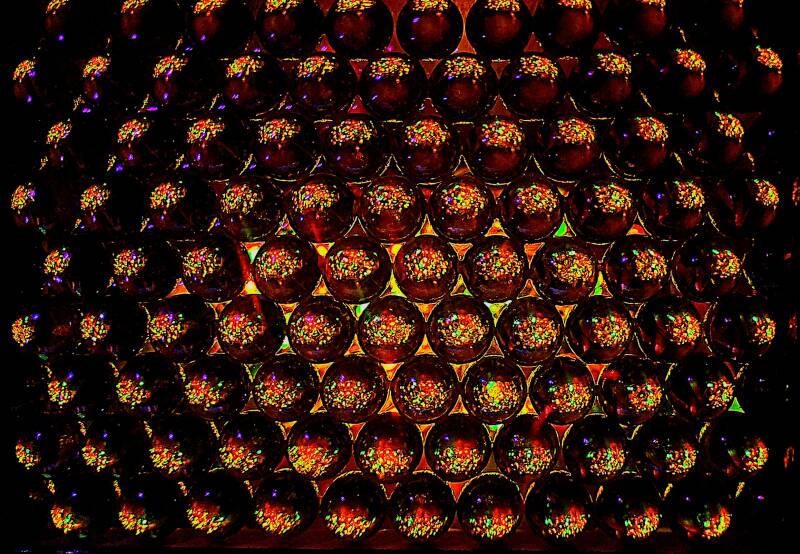
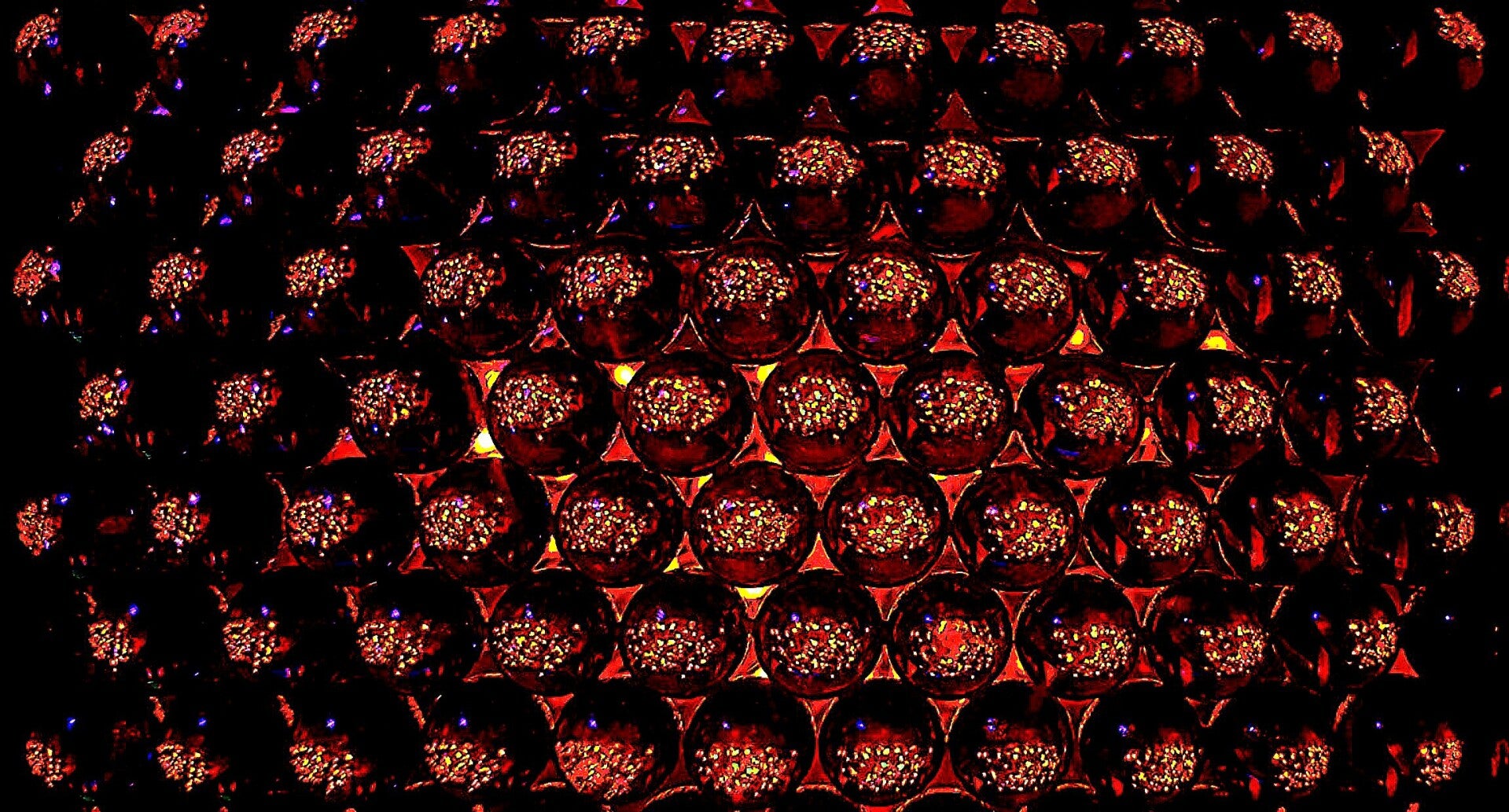
3.] Optical Tapestries: Painted, textured, or otherwise optically treated artistic surfaces provide opportunities for combining the moving laser trajectories with established geometric compositions.
4.] Additional Experimental Surfaces: Alternative materials and optical treatments may be investigated for their capacity to modify the appearance, distribution, or persistence of incident laser illumination.
5.] Light-Diffusing Surfaces: Translucent, textured, or scattering materials disperse incident laser light, potentially producing softened luminous regions, expanded beam patterns, and spatially distributed optical effects.
These surface categories may be employed independently or combined within a single installation.
C.) Kinetic Beam Capture — Calder Meets Millevolte:
A larger installation may incorporate suspended kinetic targets inspired by the mobile sculptures of Alexander Calder.
Rather than relying exclusively upon stationary receiving surfaces, the laser trajectories would intersect suspended elements capable of independent mechanical movement.
These targets may incorporate photoluminescent coatings, fluorescent painting, diffusing materials, or other optical treatments.
Their movement introduces an additional variable into the projected composition.
The laser beam moves because of the pendulum's oscillation, while the receiving target moves independently within the installation.
The resulting interaction combines two distinct forms of kinetic activity.
1.] Moving Light Source: The suspended laser assembly generates changing beam trajectories.
2.] Moving Receiving Surface: Suspended sculptural elements introduce independently changing positions and orientations.
3.] Variable Beam Intersection: The location and duration of laser contact change according to the relative motion of the beam and receiving surface.
4.] Compound Kinetic Composition: The visible result emerges from the interaction of two moving systems rather than a single moving apparatus.
5.] Modular Installation: Individual suspended targets may be repositioned to investigate different spatial relationships and optical effects.
The proposed artistic dialogue, Calder Meets Millevolte, connects the tradition of suspended kinetic sculpture with contemporary optomechanical investigations of projected light.
The reference is to Calder-inspired sculptural principles rather than the incorporation of original Calder artworks.
Excellent addition. This introduces a volumetric embodiment, distinct from projection onto solid surfaces.
7.] Atmospheric Beam Visualization. Fog and Volumetric Luminous Trajectories:
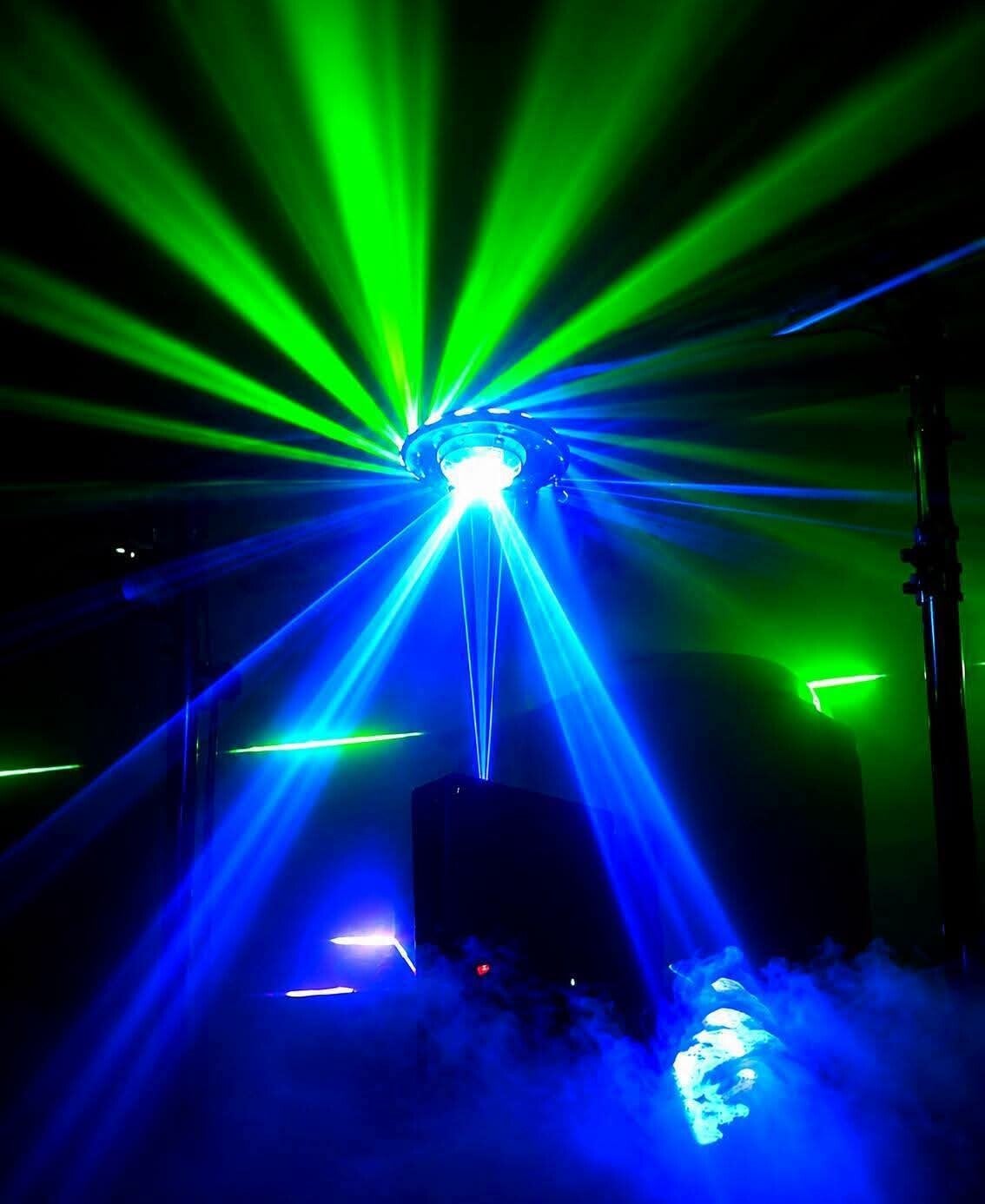
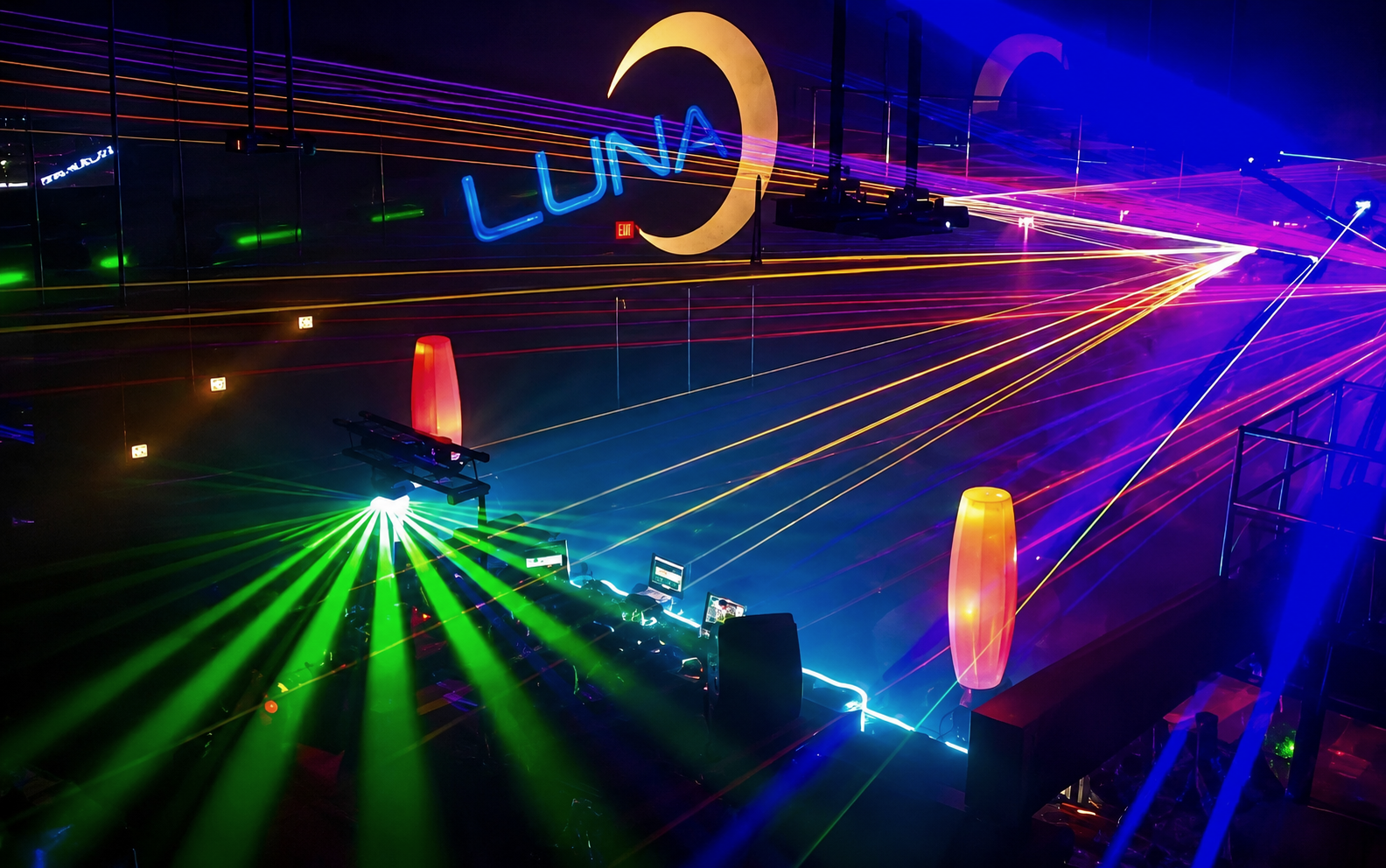
The introduction of controlled atmospheric fog permits the Magnetic and Air-Driven Laser Pendulum to generate visible three-dimensional beam trajectories within the surrounding space.
Unlike conventional surface projection, which reveals the location where a laser beam intersects a receiving surface, suspended fog droplets scatter portions of the laser light toward the observer throughout the beam's path. As the pendulum oscillates, its four laser diodes sweep through the illuminated volume, producing changing spatial arrangements of luminous rays.
A.) Three-Dimensional Beam Visualization: Atmospheric scattering reveals the paths of laser beams through space, transforming otherwise largely invisible beam trajectories into observable volumetric compositions.
B.) Repetitive Beam Trajectories: Repeated pendular movements cause the beams to traverse corresponding regions of the fog-filled environment, producing recurring luminous paths.
C.) Temporal Visual Persistence: Rapidly repeated beam movements may produce the perceptual appearance of continuous luminous surfaces, fans, or overlapping rays. This effect depends upon beam velocity, repetition frequency, scattering intensity, and human temporal visual integration.
D.) Radial Beam Expansion: The four laser diodes project outward from the suspended assembly. Their changing orientations produce an expanding and contracting arrangement of visible rays that appear to fan outward through the surrounding atmosphere.
E.) Compound Volumetric Geometry: Multiple beams moving simultaneously may produce intersecting cones, sweeping planes, curved apparent surfaces, and changing three-dimensional geometric formations.
F.) Variable Atmospheric Density: Changes in fog concentration influence beam visibility, scattering intensity, contrast, and the perceived depth of the luminous composition.
G.) Spatial and Temporal Integration: The combination of visible beam paths, repeated trajectories, and observer-dependent temporal integration introduces the appearance of luminous geometry occupying three-dimensional space.
The fog does not physically preserve the laser trajectories after the beams move away. Apparent persistence results from repeated illumination and temporal visual processing. The resulting composition transforms the surrounding atmosphere into an active optical medium, allowing the pendulum's moving laser beams to generate luminous volumetric geometry rather than relying exclusively upon solid receiving surfaces.
8.] Photoluminescence and the Temporal Persistence of Light:
Photoluminescent receiving surfaces introduce an additional temporal dimension.
Unlike ordinary diffuse surfaces, which scatter incident light primarily while illuminated, appropriately selected phosphorescent materials may continue emitting visible light after excitation has ceased.
A moving laser beam may therefore produce a temporarily persistent luminous trace.
The duration and brightness of that trace depend upon the material's excitation characteristics, incident wavelength, optical power, exposure duration, and decay behavior.
A.) Excitation: Incident laser radiation supplies energy capable of activating a compatible photoluminescent material.
B.) Temporary Energy Storage: Certain phosphorescent materials retain part of the absorbed excitation energy in metastable states.
C.) Delayed Emission: Stored energy is released over time as visible radiation, producing an afterglow.
D.) Moving Optical Traces: As the laser spot traverses the surface, successive regions may remain luminous for different periods.
E.) Temporal Layering: Newly illuminated trajectories may overlap with fading earlier trajectories, producing compound luminous compositions.
The visual result depends upon the relationship between beam velocity, excitation efficiency, and photoluminescent decay.
A rapidly moving beam may provide insufficient exposure to generate a strong visible trace, while a slower trajectory may produce greater local excitation.
Experimental selection of compatible laser wavelengths and photoluminescent materials is therefore essential.
9.] Tabletop Prototype — Cubic Experimental Framework:
A compact tabletop prototype offers a practical means of investigating the Magnetic and Air-Driven Laser Pendulum's optical behavior before developing a larger architectural installation. The proposed experimental framework draws upon the cubic structural arrangement employed in Millevolte's earlier Cosmic Flowers investigations. A stationary cubic frame provides support for adjustable receiving panels positioned within the projected beam trajectories.
A.) Compact Suspended Assembly: Smaller laser diodes and a proportionately scaled suspension permit investigation within a limited working volume.
B.) Cubic Structural Frame: The surrounding framework provides defined spatial reference points for the arrangement of receiving surfaces.
C.) Adjustable Suspended Panels: Panels may be supported by four-point string suspensions, permitting adjustment of their height, orientation, and position.
D.) Photoluminescent Materials: Selected panels may incorporate compatible phosphorescent coatings to investigate temporary luminous traces.
E.) Variable Surface Geometry: Different panel angles and positions allow comparison of projected trajectories, optical velocity, and illuminated surface area.
F.) Adjustable Magnetic Arrangement: Individual magnets may be repositioned to investigate different pendular trajectories within the compact apparatus.
G.) Controlled Airflow: A small fan or comparable airflow source may provide repeatable mechanical excitation. The tabletop prototype is intended as a stationary-target experimental configuration. It does not require the suspended mobile elements proposed for larger installations. Its primary purpose is to investigate the interaction of magnetic placement, aerodynamic excitation, laser motion, and receiving-surface imagery.
10.] Outdoor Wind-Driven Embodiments:
Outdoor configurations introduce natural atmospheric conditions as an active mechanical component of the sculpture.
Rather than employing mechanically generated airflow, the suspended assembly may receive excitation directly from ambient wind.
A.) Wind Velocity:
Changes in wind speed influence the aerodynamic forces acting upon the suspended assembly.
B.) Wind Direction:
Changing airflow direction may alter the pendulum's movement and resulting optical trajectories.
C.) Turbulence:
Irregular atmospheric motion may introduce complex or changing oscillatory behavior.
D.) Magnetic Placement:
Individually positioned magnets provide an additional means of influencing the response to naturally varying aerodynamic forces.
E.) Architectural Projection:
Appropriate receiving surfaces may be incorporated into outdoor structures, enclosed installations, or designated projection environments.
F.) Environmental Protection:
Outdoor embodiments require suitable protection against precipitation, dust, temperature variation, and other environmental conditions. Outdoor installations would also require carefully engineered laser-beam containment. Unrestricted projection into open public space or the sky is not an acceptable operating assumption. The resulting system would transform naturally occurring atmospheric movement into changing luminous compositions.
11.] Indoor Forced-Air Embodiments:
Indoor installations offer greater control over the aerodynamic excitation supplied to the pendulum. Fans, blowers or other airflow-generating equipment may be positioned to influence the suspended assembly.
A.) Airflow Velocity:
Changing fan speed modifies the aerodynamic forces available to excite the pendulum.
B.) Airflow Direction:
Repositioning the airflow source changes the direction of the applied force.
C.) Airflow Distribution:
Concentrated or distributed airflow may produce different mechanical responses.
D.) Airflow Frequency:
Duration and frequency of air propulsion can produce different mechanical responses.
E.) Magnetic Interaction:
Individual magnetic placement introduces additional control over the resulting trajectory.
F.) Environmental Stability: Indoor conditions reduce some of the variability associated with outdoor wind, allowing more repeatable experiments.
G.) Controlled Optical Environment:
Interior architectural surfaces provide opportunities for coordinated projection, beam capture, and controlled ambient illumination. The combined adjustment of airflow and magnetic placement provides two distinct means of influencing the suspended assembly. Airflow supplies mechanical excitation, while magnetic arrangement modifies the resulting motion.
12.] Compound Motion and Three-Dimensional Optical Composition:
The Magnetic and Air-Driven Laser Pendulum combines mechanical motion occurring within three-dimensional space with projected optical trajectories distributed across surrounding surfaces. The suspended assembly may move through changing combinations of angular displacement, orbital movement, and rotational orientation. Its laser beams translate these movements into visible trajectories.
A.) Mechanical Trajectory:
The physical path followed by the suspended assembly.
B.) Beam Orientation:
The changing direction of each laser diode as the assembly moves.
C.) Projection Imagery:
The relationship between the moving beam and the receiving surface.
D.) Apparent Optical Velocity:
The speed at which the illuminated point travels across a receiving surface.
E.) Multiple Simultaneous Trajectories:
The compound composition produced by the four laser diodes.
F.) Temporal Visual Experience:
The observer's perception of continuously changing luminous positions and movement. The resulting visual composition is not a conventional two-dimensional animation projected from a stationary image-generating system. It is a spatially distributed optical event arising from physical movement.
12.] Historical Context: From Suspended Kinetic Sculpture to Luminous Calligraphy:
The Magnetic and Air-Driven Laser Pendulum occupies a conceptual intersection between kinetic sculpture, mechanical experimentation, and the artistic use of projected light.
Alexander Calder's suspended mobiles established an influential artistic language in which balance, gravity, air movement, and spatial arrangement become integral components of sculptural composition.
Millevolte's Magnetic and Air-Driven Laser Pendulum investigates related mechanical principles while introducing moving sources of concentrated illumination. The resulting optical trajectories extend the apparent visual composition beyond the physical dimensions of the suspended apparatus.
A.) Suspended Kinetic Sculpture:
The use of gravity, balance, and environmental forces to produce changing spatial relationships.
B.) Magnetic Kinetic Art:
The use of magnetic interaction to influence the movement of physical sculptural elements.
C.) Optical and Light Art:
The use of illumination as an active component of artistic composition.
D.) Luminous Calligraphy:
The transformation of moving projected points into continuously evolving line-like visual experiences.
E.) Calder Verses Millevolte:
A proposed installation combining Calder-inspired suspended luminous kinetic mobiles with Millevolte's moving laser excitation. Mobile targeted surfaces may be treated with photoluminescent pigmentation, reflective mosaics and materials, or have light diffusing properties. The historical comparison establishes artistic context only..
13.] Scalable Installations and Institutional Applications:
The apparatus may be developed across several scales, from compact experimental prototypes to larger architectural installations.
A.) Tabletop Experimental Sculpture: A small cubic framework incorporating adjustable magnetic elements, controlled airflow, and stationary receiving panels.
B.) Interior Gallery Installation: A suspended laser assembly projecting across designated architectural surfaces and experimental beam-capture materials.
C.) Suspended Kinetic Target Installation: A larger configuration incorporating independently moving receiving surfaces inspired by the principles of suspended mobile sculpture.
D.) Outdoor Wind-Driven Sculpture: A weather-resistant configuration utilizing natural airflow, with appropriate optical containment and environmental engineering.
E.) University Research and Development: An interdisciplinary investigation involving mechanical dynamics, magnetic fields, aerodynamic excitation, laser optics, photoluminescent materials, and human visual perception. These configurations represent different levels of fabrication complexity, engineering requirements, and institutional investment. A tabletop prototype may provide an initial means of demonstrating the underlying principles before pursuing a larger commission.
14.] Engineering, Optical Safety, and Experimental Validation:
The proposed apparatus incorporates established principles of pendular dynamics, aerodynamic forcing, magnetic interaction, and geometric optics. However, specific trajectories, operating ranges, optical velocities, and photoluminescent effects require experimental verification.
A.) Mechanical Stability: Suspension components must accommodate the mass, movement, and operating loads of the laser assembly.
B.) Magnetic Compatibility: The moving assembly must incorporate appropriate magnetic materials or components capable of interacting with the selected magnetic field arrangement.
C.) Aerodynamic Performance: The suspended assembly must possess sufficient aerodynamic coupling to respond to the intended airflow conditions.
D.) Optical Geometry: Projection distances and receiving-surface orientations must be evaluated to determine the resulting beam trajectories and apparent velocities.
E.) Laser Safety: All embodiments require appropriate laser classification, controlled beam paths, prevention of direct and hazardous reflected eye exposure, and suitable termination of projected beams. Public installations require professional laser-safety assessment and compliance with applicable regulations.
F.) Photoluminescent Compatibility: Materials must be selected and tested for their response to the laser wavelengths and exposure conditions employed.
G.) Outdoor Environmental Protection: Outdoor embodiments require appropriate weather resistance, structural stability, electrical protection, and consideration of public access and aviation hazards.
The scientific objective is to characterize the relationship between magnetic placement, aerodynamic excitation, mechanical motion, projection geometry, and optical response.
15.] Continuity of Artistic Principles:
The Magnetic and Air-Driven Laser Pendulum extends Millevolte's established investigation of mechanical motion as a means of generating optical phenomena. Rather than relying upon programmed imagery, the apparatus creates changing luminous compositions through the physical interaction of forces and materials.
Airflow supplies mechanical excitation. Magnetic placement influences the pendulum's trajectory. The suspended laser assembly transforms that movement into changing beam orientations. Spatial arrangement determines how those beams intersect receiving surfaces.
The resulting visual experience may take the form of uninterrupted luminous calligraphy, temporary photoluminescent traces, reflected trajectories, diffused luminous fields, or interactions with independently moving sculptural targets. Each configuration preserves the same underlying relationship between physical movement and optical transformation.
The Magnetic and Air-Driven Laser Pendulum transforms the movement of a suspended light source into an expansive visual language, using magnetic placement to influence mechanical trajectories and spatial arrangement to translate those trajectories into changing optical velocity.
Descriptions of tabletop prototypes, outdoor embodiments, kinetic receiving surfaces, and monumental installations represent proposed developments unless otherwise documented as completed. Historical comparisons with Alexander Calder and other kinetic-art traditions establish artistic context.
© 2026 Michael Millevolte. All Rights Reserved.
Original artwork, sculptural compositions, documentation, and associated artistic terminology are subject to applicable intellectual property protections. Proprietary mechanical systems, optical arrangements, and functional inventions may be eligible for patent protection, subject to applicable legal requirements. All applicable rights reserved.