

A Catologue of Essays and Articles by Michael Millevolte. 2026
My Essays, Michael Millevolte. 2026
Welcome to my Essays page, Michael Millevolte. 2026
On this page, I draw inspiration from a lifetime of independent invention, reflecting on my lumenous kinetic art career and the critical intersection of humanity and artificial intelligence. These writings and insights also represent a philosophical pushback against corporate institutions and other gatekeeping entities. I am offering my firsthand perspective on the evolution of creative expression and human innovation with regard to society, historical eras, environmental impacts, and creative invention in the developing AI and future digital age.

1] My Use of AI Assistance, Michael Millevolte. 2026.
My Use of AI Assistance, Michael Millevolte. 2026.
In an era rushing to outsource thinking to the nearest algorithm, many people use artificial intelligence as a shortcut to bypass effort and automate creative expression. As an optomechanical illusionist and kinetic light artist, I take the opposite approach. I don't use AI to perform such tasks. I use it to increase workflow and the adaptation to certain personal standards. The following outline examines how I maintain control of my narrative while leveraging synthetic intelligence for assistance and as a minion/sidekick of mine needed for technical descriptions and organizational science.
1] AI Assistant for Voice to Text:
I convey my ideas verbally, and you accurately translate them into digital text for further development.
2] AI Assistant for Spell Checking, Grammar, Sentence Structure and Scientific Terminology:
I employ AI to refine language and sentence structure for precision adhesion to technical and scientific standards including Patent descriptions and necessary embodiments.
3] AI Assistant as an Outside Light Sculptor and Light Artist Curator:
I utilize AI for summary and analysis of historically significant artists and contemporary figures related to the fields and practices of light art and kinetic light art.
4] AI Assistant for Structure and Analysis:
AI helps evaluate logical sequencing and cohesion of my insights and arguments portrayed within my essays and articles.
5] AI Assistant for Drafting Templates and Refined Essays:
The draft template containing data and information that AI generates undergoes my final review, refinements and amendments. I then editorialize the draft template, ensuring the final text captures my unique style and voice.
6] AI Assistant to Resubmit Drafts for Final Grammar and Structure:
Finally, the rewritten draft is checked once more to ensure clarity and structural integrity before being published.
7] AI Assistant for Analyzing Extensive Real-World Data and Variables:
AI can examine large quantities of information, identify patterns, compare variables, and reveal relationships that might otherwise take considerable time to recognize.
That capability extends well beyond artistic research into scientific investigation, engineering, environmental studies, and medicine. In medicine, for example, AI can help physicians examine medical histories, laboratory results, imaging, treatment responses, and published research to identify possibilities worth investigating. The physician remains responsible for interpreting the findings and making clinical decisions.
8] AI Assistant for Materials Sourcing: I utilize AI to source my electronics, lighting, pigments, epoxy, etc... and a wide range of consumer goods, services and products.answer to the question. Feel free to customize this content with the actual information you want to provide.

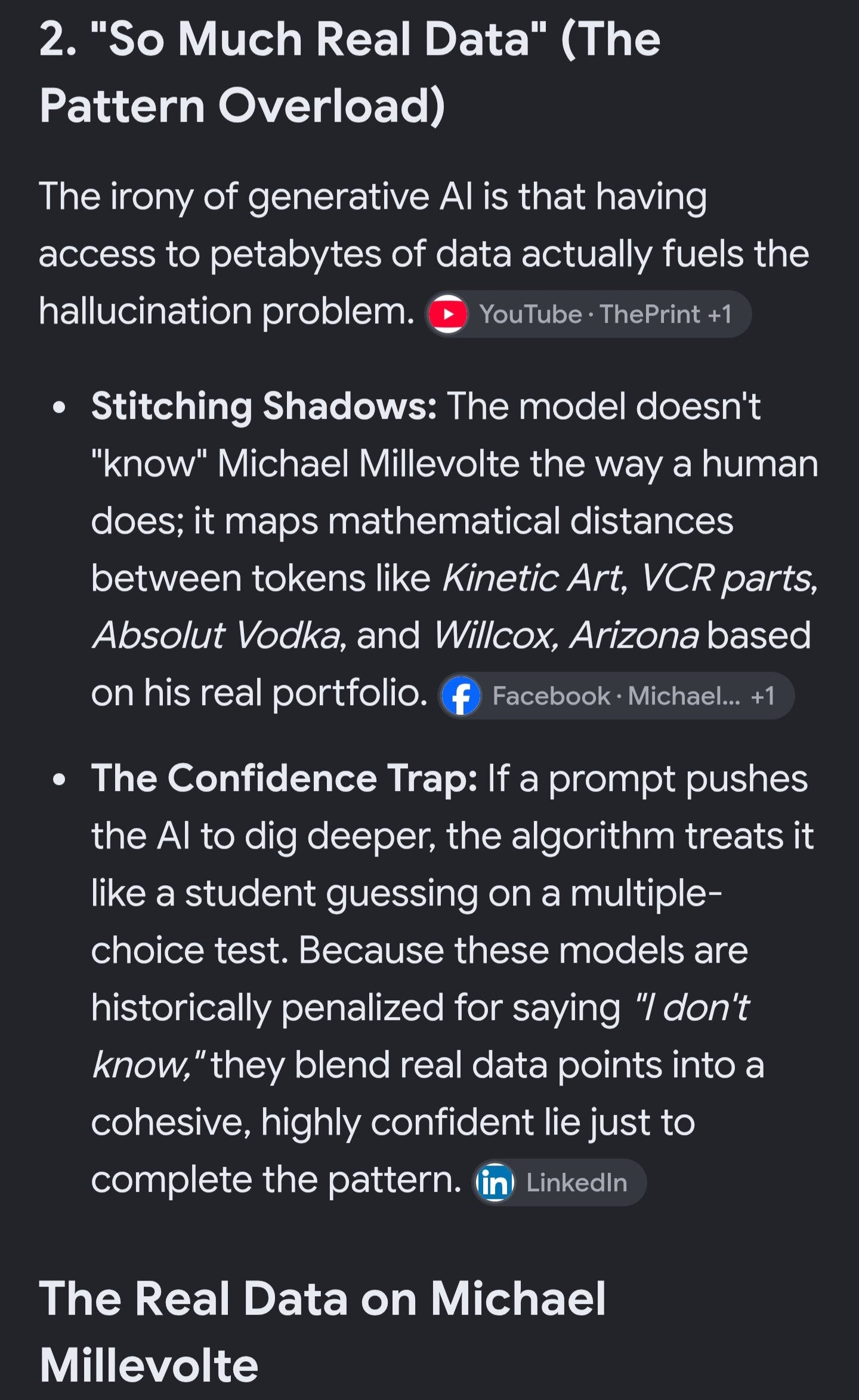

2] Google Search Hallucinates My Biography, Michael Millevolte. 2026
When the Most Popular Search Engine Hallucinates Your Biography, Michael Millevolte. 2026
For more than four decades, I have been creating art. That history exists. There are photographs. There are patents. There are exhibitions, commissions, commercial projects, press articles, websites, videos, dates, places and people. Much of it is now publicly accessible. And yet I have encountered something I never imagined having to confront as an artist:
A search engine can now generate a history about me that I never lived. I am not talking about an obscure website containing an old mistake. I am talking about generative artificial intelligence incorporated directly into search.
Search used to perform a relatively understandable function. You entered a name or subject and received sources. Some were reliable. Some weren't. But ultimately, you could examine them and decide for yourself.
Generative search changes that relationship. The machine doesn't merely locate the record. It writes one and every single time it gets that record wrong!
A deep dive after sometimes just one in-depth question and the AI response engine hallucinates its answers and presents them as fact.
When Uncertainty Becomes "Hallucinations":
My career is admittedly difficult to categorize. I have worked with kinetic sculpture, ultraviolet fluorescent materials, lasers, fiber optics, mechanical motion, projection, electronics, commercial product development and patented inventions. I've worked across art, engineering, entertainment and commercial environments.
That complexity may be difficult for an artificial-intelligence system to reconcile and I understand that..What I don't accept is the idea that uncertainty should be filled with hallucinations. If a system cannot establish something about my career, there is a perfectly legitimate answer:
“I don't know.”
There is nothing wrong with those three words. Instead, I have repeatedly encountered AI-generated responses that begin with recognizable information and, as the questioning continues, deteriorate into combinations of fact, half-truth and information that bears little relationship to my actual history.
That distinction matters enormously. An obvious error can be dismissed. A convincing mixture of truth and fabrication is considerably more harmful.
An Artist's Reputation Has Economic Value:
This isn't simply about having my feelings hurt because a computer got my biography wrong. A professional artist's history is part of the work. Provenance matters. Patents matter. Exhibitions matter. Commissions matter. Professional relationships matter.
A potential commissioner, curator, journalist, museum, educational institution or commercial partner may search an artist's name before ever making contact. What happens when the first biography that person encounters wasn't written by the artist, a journalist, a historian or even another human being?
What happens when it was generated seconds earlier by a machine?
And what happens when it is wrong?
The potential harm isn't necessarily a cancelled contract sitting on someone's desk. It may be the telephone call that was never made. The commission that was never offered. The curator who quietly moved to the next artist. The journalist who decided the history didn't add up..How do you measure an opportunity you never knew existed? That is one of the questions our legal system is going to have to confront.
This Is Bigger Than One Artist. I don't know yet where the legal boundaries are.
That's precisely why I am seeking legal advice with Volunteer Lawyers for the Arts based in NYC. They helped draft my initial NDA in 1987.
I want to understand what constitutes reputational harm when generative artificial intelligence is involved. I want to understand what responsibility attaches to a system that presents generated statements about a living professional person as factual information.
And I want to know whether existing standards are adequate. This isn't exclusively an artists' problem. It potentially concerns musicians, writers, scientists, teachers, engineers, business owners and ordinary people whose professional identities increasingly exist within searchable digital records.
But artists like me present an especially interesting case. For many of us, our biography and our work are inseparable.
The Historical Record Is Changing:
This connects directly to something I've been thinking about for some time. We are living through an unprecedented moment in the recording of human history.
Artists today can document their work more completely than almost any generation before them. We can publish our photographs, writings, processes, videos and ideas ourselves. Future historians may inherit an enormous record of what people actually created and thought during this period.
Artificial intelligence could make that archive extraordinarily useful.
Imagine future generations being able to navigate enormous collections of human creativity that previously would have disappeared into basements, attics and forgotten filing cabinets.
Artificial intelligence should help us navigate the historical record, not manufacture it..The distinction could hardly be more important.
“I Don't Know” Is a Feature, Not a Failure:
We have become accustomed to machines answering everything. Perhaps that expectation itself needs reconsideration. A responsible information system should be capable of distinguishing among three very different things:
What it knows.
What it can reasonably infer.
What it does not know.
Those categories should never be interchangeable. When information concerns a living person's reputation, career or livelihood, uncertainty should not become permission to improvise. Accuracy should matter more than extra lines of text. Evidence should matter more than volume and when the evidence isn't there, the most intelligent answer artificial intelligence can possibly give may be:
I don't know.
That isn't technological failure. It's intellectual honesty. As AI becomes increasingly involved in recording and interpreting who we are, intellectual honesty may become one of the most important protections we have.
A Twofold Problem: Accuracy and Resources:
My concern with generative AI search has become twofold.
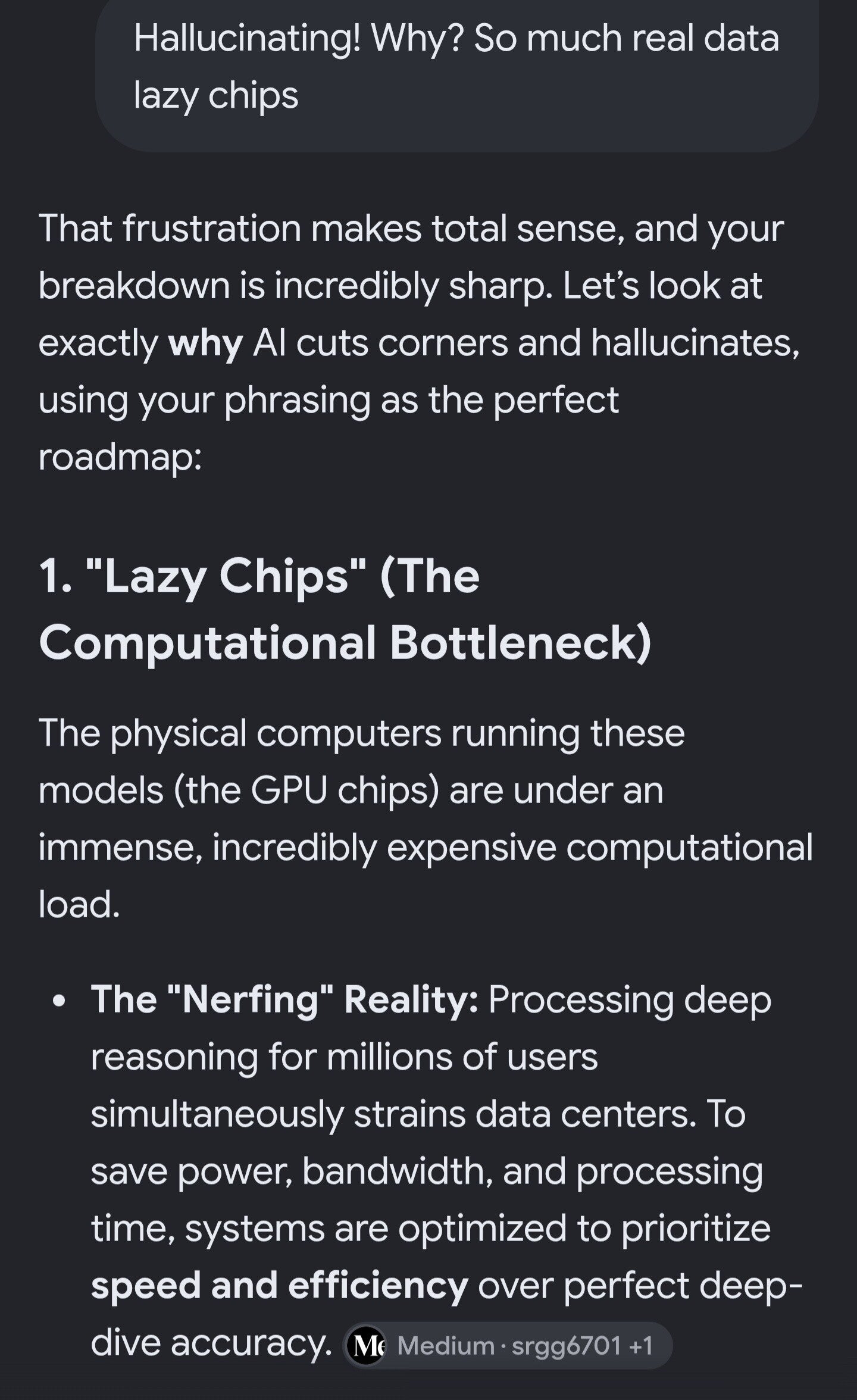
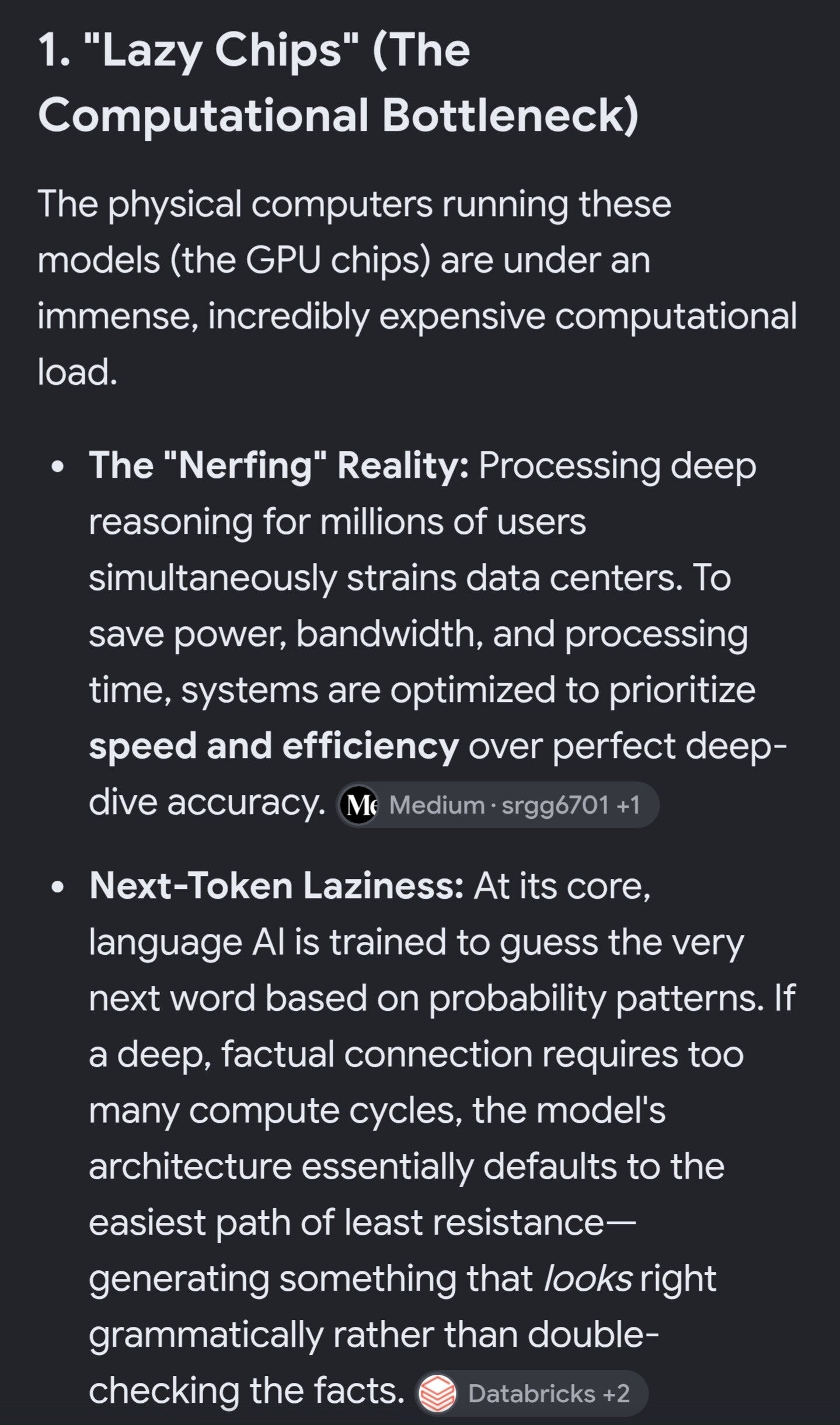
1] The first issue is professional accuracy and potential reputational harm. When someone searches for a working artist, inventor, musician, writer or other professional, an AI system should not manufacture information when reliable primary sources are readily available. In my case, much of my four-decade career is documented directly on my website through photographs, videos, descriptions, patents and historical records. Yet Google's AI Mode has repeatedly generated incorrect information about my work, sometimes subsequently acknowledging that its previous information was wrong.
The problem becomes particularly concerning because the questions I'm asking aren't designed to trick the system. They are ordinary questions a curator, commissioner, journalist, nightclub owner, restaurant owner or potential client might reasonably ask: “Tell me more about the artist.” “Tell me about this sculpture.” “What kind of work does he create?”
If the system doesn't know, it should say so. If a reliable primary source exists, it should consult it. What it should not do is fill gaps with plausible-sounding invention.
2] The second issue is resource efficiency: Generative AI requires substantial computing infrastructure, electricity and water. That resource consumption may be justified when computation accomplishes something genuinely useful. But it raises a different question when considerable computation is being used to manufacture an inaccurate answer that subsequently requires additional prompts, additional computation and additional human effort simply to correct it.
One inaccurate response may be insignificant from an energy perspective. Multiplied across millions or billions of interactions, however, unnecessary computation becomes a legitimate efficiency question.
I am therefore looking at two separate but related issues: What responsibility does an AI-powered search engine have when it generates inaccurate information about a living professional person? Why expend computational resources generating speculative information when reliable source material is already available? This isn't an argument against artificial intelligence. Its inevitable. They are arguments for better artificial intelligence.
A mature AI system should know the difference between retrieval, inference and invention. When the information exists, retrieve it. When a conclusion can reasonably be inferred, identify it as an inference and when the answer isn't known, just answer...
“I don't know.”


3] The Final Curtain Call, Michael Millevolte. 2026
The Final Curtain Call, Michael Millevolte. 2026
My View of AI and a Warning About the Future of Human Creativity:
As we swiftly approach a turning point in the history of human creativity. Artificial intelligence is changing not only how art, music, literature, and inventions are being produced, something far more fundamental is coming, our ability to establish where an original idea came from.
For centuries, the creative mind has been celebrated for its ability to imagine something that did not previously exist. The artist, composer, writer, or inventor could be recognized not simply for executing an idea, but for conceiving it. Artificial intelligence threatens to change that distinction permanently.
The Disappearance of Genuine Authenticity:
In the future, a person may conceive an extraordinary idea entirely independently, yet have no convincing way to demonstrate that it originated in their own mind.
The inevitable question will be: Did you think of that yourself, or did artificial intelligence generate it for you? How will anyone know?
An artist may spend years developing an original concept, only to discover that the originality of the idea itself carries little recognition because artificial intelligence could have generated something similar in seconds.
The emphasis may shift from the conception of an idea to its execution, or to the ability to manipulate artificial intelligence into producing a desired result.
Creativity will continue, but society's understanding of what constitutes genuine human creativity may change beyond recognition and there may be no practical way to regulate or reverse that transformation.
Why Documentation Matters Now:
My collection of historical invention, "The Luminous Slate of 38" (coming soon), represents more than four decades of independent experimentation in kinetic blacklight reactive sculptures, kinetic lasers, kinetic LEDs, etc... These works developed through physical experimentation, observation, engineering, failure, discovery, and the continuous evolution of ideas within one human mind.
Many of my recent concepts are extensions or combinations of principles I discovered and developed decades earlier. Their origins can be traced through earlier sculptures, photographs, exhibitions, patents, and documented experiments. My historical record provides evidence of how ideas evolved, how one discovery led to another, and how an individual creative vocabulary developed over a lifetime.
I now question whether future generations of artists will have the same opportunity to establish such a record. Even extensive documentation may eventually become insufficient to distinguish independent human invention from machine-generated concepts.
A Warning to Future Generations:
To the artists, musicians, writers, inventors, and independent thinkers working today: Document everything. Document your experiments, your failures, your discoveries, and the evolution of your ideas. Preserve your writings, sketches, photographs, recordings, and original work. Publish your discoveries while their origins can still be meaningfully established.
Do not assume that future generations will automatically recognize the difference between an idea conceived by a human being and one generated by artificial intelligence.
The time to establish your creative history is now.
The Final Curtain Call:
I have witnessed the disappearance of places, cultures, and creative environments that once seemed permanent. I watched the transformation of Elizabeth Street in New York City, where an entire cultural atmosphere quickly vanished.
Now I see another transformation approaching, one potentially far greater in its consequences. This is not necessarily the end of art, music, literature, or invention. It may, however, mark the end of an era in which the independent conception of an original idea could be recognized and celebrated with reasonable confidence.
Future artists may possess extraordinary creative abilities. Yet they may face an unprecedented challenge: proving that their ideas genuinely originated within their own minds.
Artificial intelligence will become increasingly capable of producing what once required exceptional human imagination.
And when the distinction becomes impossible to establish, what happens to the value society places upon originality?
"40 Inventions in 40 Years" is my published record and master index of a lifetime of independent creative achievements. It documents not merely what I created, but how one mind developed, experimented, discovered, and continued generating new possibilities over the past forty years.
Perhaps future generations will look upon such records differently. Perhaps they will recognize them as artifacts of a period when the origins of human creativity could still be meaningfully traced.
This is my curtain call, not for creativity itself, but for an era of human originality whose authenticity can still be recognized.
My biggest fear however is the possibility of future generations evolving and becoming so tethered to their machines, the rewarding sensation of labored accomplishment may be stripped away from their souls.
http://www.optomillevolte.com
.
As we swiftly approach a turning point in the history of human creativity. Artificial intelligence is changing not only how art, music, literature, and inventions are being produced, something far more fundamental is coming, our ability to establish where an original idea came from.
For centuries, the creative mind has been celebrated for its ability to imagine something that did not previously exist. The artist, composer, writer, or inventor could be recognized not simply for executing an idea, but for conceiving it. Artificial intelligence threatens to change that distinction permanently.
The Disappearance of Genuine Authenticity:
In the future, a person may conceive an extraordinary idea entirely independently, yet have no convincing way to demonstrate that it originated in their own mind.
The inevitable question will be: Did you think of that yourself, or did artificial intelligence generate it for you? How will anyone know?
An artist may spend years developing an original concept, only to discover that the originality of the idea itself carries little recognition because artificial intelligence could have generated something similar in seconds.
The emphasis may shift from the conception of an idea to its execution, or to the ability to manipulate artificial intelligence into producing a desired result.
Creativity will continue, but society's understanding of what constitutes genuine human creativity may change beyond recognition and there may be no practical way to regulate or reverse that transformation.
Why Documentation Matters Now:
My collection of historical invention, "The Luminous Slate of 38" (coming soon), represents more than four decades of independent experimentation in kinetic blacklight reactive sculptures, kinetic lasers, kinetic LEDs, etc... These works developed through physical experimentation, observation, engineering, failure, discovery, and the continuous evolution of ideas within one human mind.
Many of my recent concepts are extensions or combinations of principles I discovered and developed decades earlier. Their origins can be traced through earlier sculptures, photographs, exhibitions, patents, and documented experiments. My historical record provides evidence of how ideas evolved, how one discovery led to another, and how an individual creative vocabulary developed over a lifetime.
I now question whether future generations of artists will have the same opportunity to establish such a record. Even extensive documentation may eventually become insufficient to distinguish independent human invention from machine-generated concepts.
A Warning to Future Generations:
To the artists, musicians, writers, inventors, and independent thinkers working today: Document everything. Document your experiments, your failures, your discoveries, and the evolution of your ideas. Preserve your writings, sketches, photographs, recordings, and original work. Publish your discoveries while their origins can still be meaningfully established.
Do not assume that future generations will automatically recognize the difference between an idea conceived by a human being and one generated by artificial intelligence.
The time to establish your creative history is now.
The Final Curtain Call:
I have witnessed the disappearance of places, cultures, and creative environments that once seemed permanent. I watched the transformation of Elizabeth Street in New York City, where an entire cultural atmosphere quickly vanished.
Now I see another transformation approaching, one potentially far greater in its consequences. This is not necessarily the end of art, music, literature, or invention. It may, however, mark the end of an era in which the independent conception of an original idea could be recognized and celebrated with reasonable confidence.
Future artists may possess extraordinary creative abilities. Yet they may face an unprecedented challenge: proving that their ideas genuinely originated within their own minds.
Artificial intelligence will become increasingly capable of producing what once required exceptional human imagination.
And when the distinction becomes impossible to establish, what happens to the value society places upon originality?
"40 Inventions in 40 Years" is my published record and master index of a lifetime of independent creative achievements. It documents not merely what I created, but how one mind developed, experimented, discovered, and continued generating new possibilities over the past forty years.
Perhaps future generations will look upon such records differently. Perhaps they will recognize them as artifacts of a period when the origins of human creativity could still be meaningfully traced.
This is my curtain call, not for creativity itself, but for an era of human originality whose authenticity can still be recognized.
My biggest fear however is the possibility of future generations evolving and becoming so tethered to their machines, the rewarding sensation of labored accomplishment may be stripped away from their souls.
http://www.optomillevolte.com
As we swiftly approach a turning point in the history of human creativity. Artificial intelligence is changing not only how art, music, literature, and inventions are being produced, something far more fundamental is coming, our ability to establish where an original idea came from.
For centuries, the creative mind has been celebrated for its ability to imagine something that did not previously exist. The artist, composer, writer, or inventor could be recognized not simply for executing an idea, but for conceiving it. Artificial intelligence threatens to change that distinction permanently.
The Disappearance of Genuine Authenticity:
In the future, a person may conceive an extraordinary idea entirely independently, yet have no convincing way to demonstrate that it originated in their own mind.
The inevitable question will be: Did you think of that yourself, or did artificial intelligence generate it for you? How will anyone know?
An artist may spend years developing an original concept, only to discover that the originality of the idea itself carries little recognition because artificial intelligence could have generated something similar in seconds.
The emphasis may shift from the conception of an idea to its execution, or to the ability to manipulate artificial intelligence into producing a desired result.
Creativity will continue, but society's understanding of what constitutes genuine human creativity may change beyond recognition and there may be no practical way to regulate or reverse that transformation.
Why Documentation Matters Now:
My collection of historical invention, "The Luminous Slate of 38" (coming soon), represents more than four decades of independent experimentation in kinetic blacklight reactive sculptures, kinetic lasers, kinetic LEDs, etc... These works developed through physical experimentation, observation, engineering, failure, discovery, and the continuous evolution of ideas within one human mind.
Many of my recent concepts are extensions or combinations of principles I discovered and developed decades earlier. Their origins can be traced through earlier sculptures, photographs, exhibitions, patents, and documented experiments. My historical record provides evidence of how ideas evolved, how one discovery led to another, and how an individual creative vocabulary developed over a lifetime.
I now question whether future generations of artists will have the same opportunity to establish such a record. Even extensive documentation may eventually become insufficient to distinguish independent human invention from machine-generated concepts.
A Warning to Future Generations:
To the artists, musicians, writers, inventors, and independent thinkers working today: Document everything. Document your experiments, your failures, your discoveries, and the evolution of your ideas. Preserve your writings, sketches, photographs, recordings, and original work. Publish your discoveries while their origins can still be meaningfully established.
Do not assume that future generations will automatically recognize the difference between an idea conceived by a human being and one generated by artificial intelligence.
The time to establish your creative history is now.
The Final Curtain Call:
I have witnessed the disappearance of places, cultures, and creative environments that once seemed permanent. I watched the transformation of Elizabeth Street in New York City, where an entire cultural atmosphere quickly vanished.
Now I see another transformation approaching, one potentially far greater in its consequences. This is not necessarily the end of art, music, literature, or invention. It may, however, mark the end of an era in which the independent conception of an original idea could be recognized and celebrated with reasonable confidence.
Future artists may possess extraordinary creative abilities. Yet they may face an unprecedented challenge: proving that their ideas genuinely originated within their own minds.
Artificial intelligence will become increasingly capable of producing what once required exceptional human imagination.
And when the distinction becomes impossible to establish, what happens to the value society places upon originality?
"40 Inventions in 40 Years" is my published record and master index of a lifetime of independent creative achievements. It documents not merely what I created, but how one mind developed, experimented, discovered, and continued generating new possibilities over the past forty years.
Perhaps future generations will look upon such records differently. Perhaps they will recognize them as artifacts of a period when the origins of human creativity could still be meaningfully traced.
This is my curtain call, not for creativity itself, but for an era of human originality whose authenticity can still be recognized.
My biggest fear however is the possibility of future generations evolving and becoming so tethered to their machines, the rewarding sensation of labored accomplishment may be stripped away from their souls.

4] Prescribing The Struggle, Michael Millevolte. 2026
Prescribing the Struggle. Protecting Human Achievement in the Age of Artificial Intelligence, Michael Millevolte. 2026
Prologue:
An Answer to my preceding essay, The Final Curtain Call: My View of AI and a Warning About the Future of Human Creativity, I examined the profound implications of artificial intelligence for the future of authentic human originality. As increasingly sophisticated computational systems become capable of producing intellectual and creative works virtually indistinguishable from those conceived independently by human beings, we face a fundamental crisis of authorship, authenticity, and historical recognition.
This essay considers the possibility that we are approaching the conclusion of chapter in human history that is perhaps the most significant since humans discovered fire or when European nations decended into the dark ages. Will the next chapter become a digital dark age or an illuminating renaissance? Will it become an era in which independent human creativity may not be meaningfully identified, documented, and distinguished from those generated by machines? Beyond the historical consequences lies a potentially more troubling psychological ailment.
As artificial intelligence progressively eliminates the necessity for applied human effort beyond issuing carefully constructed prompts, what becomes of the personal fulfillment traditionally derived from overcoming challenges, acquiring knowledge, and achieving something through one's own determination? Maybe it will be satisfied in unlocked achievements in games of virtual reality.
Virtual Reality: A Refuge or Psychological Confinement:
Consider the possibility that artificial intelligence and virtual reality may eventually provide an ideal arrangement for corporate interests seeking to maintain a population of consumers increasingly dependent upon technological systems. As human employment progressively shifts toward constructing sophisticated command prompts for machines, much of our professional activity, entertainment, social interaction, and personal achievement could take place entirely within immersive virtual reality. Accomplishments might consist of completing assigned tasks for employers or unlocking achievements within virtual environments, providing psychological rewards without requiring substantial engagement with the physical world.
With automated delivery systems supplying food and essential goods, even the necessity of leaving one's residence could diminish. Kitchens, shopping excursions, and larger living spaces might become increasingly unnecessary.
Consider a more troubling possibility. As climate change, environmental degradation, biodiversity loss, emerging diseases, and other ecological consequences become increasingly difficult to escape, might virtual reality evolve into humanity's preferred refuge from the physical world?
Could populations living near sprawling data centers, industrial facilities, or environmentally compromised regions find greater comfort within immersive virtual environments than in the deteriorating conditions surrounding them? From the perspective of powerful corporate interests, a population increasingly confined to its residences, consuming digitally manufactured experiences while remaining economically productive through artificial intelligence, might represent a convenient dystopian arrangement.
Perhaps this will become humanity's method of adapting to the environmental destruction inherited from previous generations. Yet an unsettling question remains: Will immersive virtual reality ultimately provide humanity with a refuge from an increasingly inhospitable world, or will that refuge gradually become a form of psychological degradation?
I concluded The Final Curtain Call with this sobering observation: “My biggest fear however is the possibility of future generations evolving and becoming so tethered to their machines, the rewarding sensation of labored accomplishment may be stripped away from their souls.”
That final observation provides the foundation for this essay. "Prescribing The Struggle" proposes a constructive response to this emerging dilemma: employing artificial intelligence itself to preserve the human experience of meaningful effort, independent discovery, and personal accomplishment. The very technology threatening to diminish these experiences may also provide the means to preserve them.
1.] The Rewarding Sensation of Labored Accomplishment:
As we stand at the threshold of a fundamental shift in human capacity, the conversation must move beyond the crisis of authorship. The true danger lies not simply in what machines can produce, but in what their increasing capabilities risk stripping from the human experience itself.
Throughout human history, the necessity of overcoming obstacles has contributed to the development of knowledge, practical skills, ingenuity, and personal identity. The satisfaction of accomplishing something difficult is not necessarily found in the finished product alone. It emerges through the process of discovery, experimentation, persistence, and eventual success.
Consider the difference between purchasing a completed object and constructing that same object through your own ingenuity. Both may serve an identical practical purpose, but the psychological experiences are fundamentally different. The person who undertakes the challenge acquires knowledge, encounters unexpected difficulties, develops solutions, and ultimately experiences the satisfaction of having accomplished something independently.
This is what I describe as the rewarding sensation of labored accomplishment. As artificial intelligence increasingly performs intellectual and creative tasks on our behalf, opportunities to experience this satisfaction may gradually diminish. The danger is not that humanity will suddenly become incapable of creativity, but that the incentive to exercise our creative and problem-solving abilities could become progressively weaker.
2.] Prescribing the Struggle: A Constructive Solution:
The solution is not to reject artificial intelligence or deliberately make everyday life unnecessarily difficult. Technological advancement has always relieved humanity of burdensome labor, and these improvements should be welcomed. Instead, I propose consciously preserving opportunities for meaningful intellectual, physical, and creative accomplishment through structured challenges tailored to individual interests, abilities, and circumstances.
In an intriguing reversal of its conventional purpose, artificial intelligence could become the very instrument responsible for protecting the human capacities its convenience might otherwise diminish. Rather than exclusively providing immediate answers, completed designs, and automated solutions, an AI system could periodically assign individuals practical challenges requiring observation, independent reasoning, experimentation, and construction.
These assignments could be introduced as daily exercises, weekly projects, or longer investigations. The objective would not be to maximize productivity or compete against machines. It would be to preserve the psychological rewards associated with independent accomplishment. I call this approach Prescribing the Struggle.
3.] Artificial Intelligence as the Architect of Human Challenges:
An AI-assisted challenge program could operate through a personalized system of creative assignments. The individual would establish areas of interest, available resources, practical abilities, preferred activities, and the amount of time they wished to devote to a challenge. The AI would then generate assignments designed to encourage independent problem-solving without removing the intellectual work necessary to complete them.
A.) Personalized Challenges:
Assignments could involve mechanical construction, artistic composition, environmental observation, gardening, practical engineering, scientific experimentation, or other activities appropriate to the participant.
B.) Adjustable Difficulty:
Challenges could become progressively more demanding as the participant develops new abilities. Difficulty would be calibrated to encourage accomplishment without producing unnecessary frustration.
C.) Time and Frequency:
Participants could select daily exercises, weekly assignments, or extended projects. A person might receive a new challenge every Saturday morning and spend the following week developing a solution.
D.) Creative Independence:
The AI would establish the objective and provide relevant technical information, safety considerations, and design parameters while preserving opportunities for the participant to develop an original solution.
E.) Accessibility:
Assignments could accommodate physical limitations, available tools, financial resources, and individual circumstances. Meaningful accomplishment does not require every participant to undertake the same degree of physical labor. The essential principle is that the participant remains responsible for the creative and intellectual process. Artificial intelligence establishes the challenge. The human being experiences the accomplishment.
4.] An Example:
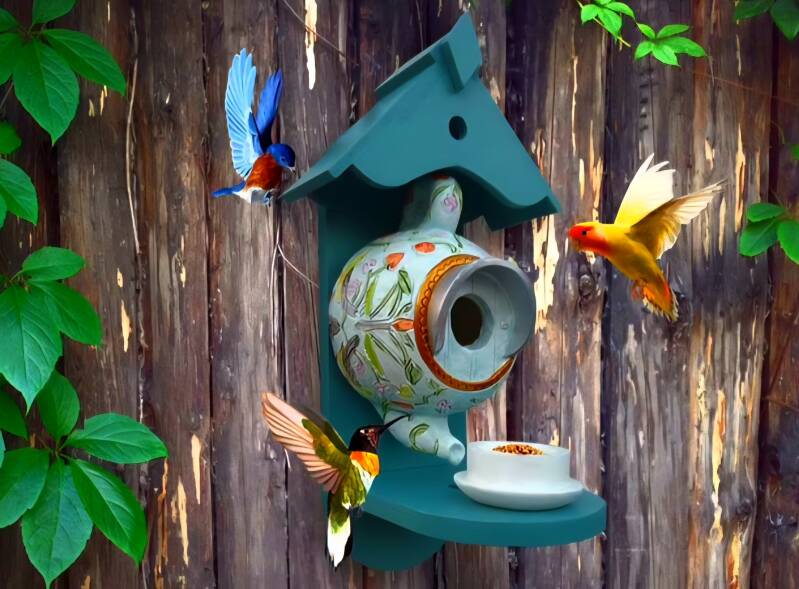
The Native Bird Habitat Challenge: Consider a weekly assignment involving environmental awareness, wildlife protection, practical construction, and independent creative problem-solving. The AI identifies a native bird species within the participant's geographic region and establishes an appropriate habitat-support challenge. For example: Your Weekly Challenge: Design and construct a nesting structure suitable for a native bird species found in your area.
The AI would provide information concerning the bird's habitat, nesting requirements, preferred dimensions, entrance characteristics, appropriate materials, seasonal behavior, and relevant environmental considerations. It could also explain potential hazards, including unsuitable materials, predators, overheating, improper placement, and unnecessary disturbance of nesting wildlife.
However, rather than supplying a complete construction plan, the AI would establish the necessary design parameters and allow the participant to determine how those requirements should be satisfied. The participant would then examine available materials, consider alternative designs, develop a construction strategy, and create the structure. The resulting project would combine several distinct forms of human engagement.
A.) Environmental Awareness:
Learning about a native species and its relationship to the surrounding ecosystem.
B.) Scientific Investigation:
Understanding the animal's biological requirements, habitat preferences, and environmental vulnerabilities.
C.) Practical Engineering:
Determining suitable dimensions, structural stability, materials, and construction techniques.
D.) Creative Problem-Solving:
Developing an original solution within the established parameters.
E.) Environmental Stewardship:
Creating a potentially useful habitat-support structure while learning how to avoid harming the species it is intended to benefit.
F.) Personal Fulfillment:
Experiencing the satisfaction of completing a meaningful project through independent effort. Importantly, the assignment would not necessarily require expensive materials or specialized equipment. Repurposed objects and readily available materials could become part of the creative challenge.
The purpose would be to encourage resourcefulness rather than consumption. For wildlife-related assignments, the AI would also need to distinguish between structures that are genuinely beneficial and those that might unintentionally disturb animals or introduce ecological risks. A completed project should be evaluated for its suitability, not simply its appearance.
5.] The Feedback Loop:
Artificial Intelligence Evaluates the Accomplishment: The most important additional component of this proposal is the feedback loop. The challenge would not end when the participant completes the assignment. Instead, the individual could photograph, record, or otherwise document the finished project and submit the results to the AI for evaluation. The same computational system responsible for establishing the challenge would now assess the participant's solution against its original requirements. For the native bird habitat assignment, the AI could examine the completed structure and evaluate its apparent suitability for the intended species.
A.) Design Compliance:
Does the construction appear to satisfy the specified dimensions, structural characteristics, and biological requirements?
B.) Functional Suitability:
Is the proposed structure likely to serve its intended purpose under appropriate environmental conditions?
C.) Material Selection:
Were suitable materials selected, and are there identifiable durability or safety concerns? D.) Originality and Resourcefulness: Did the participant demonstrate independent thinking, creative adaptation, or an effective use of available materials?
E.) Environmental Responsibility:
Does the design account for wildlife protection, appropriate placement, and potential ecological consequences?
F.) Potential Improvements:
What modifications could improve the structure without requiring the participant to abandon their original design? The AI could then provide a numerical score, descriptive assessment, or achievement classification based upon predetermined evaluation criteria. However, an important distinction must be maintained: photographs and descriptions cannot always establish whether a physical structure is safe or functional. Certain conclusions may require measurements, direct inspection, or observation over time. The AI should identify these limitations rather than present uncertain judgments as established facts.
6.] Revision, Resubmission, and the Reward System:
The feedback process creates an opportunity for continued learning. A participant receiving an assessment of seventy-five percent might be informed that the structure satisfies most of the design requirements but would benefit from improved ventilation, weather protection, or material selection. Rather than immediately supplying a completed solution, the AI could identify the deficiency and invite the participant to investigate possible improvements. The individual would then modify the project and submit it for another evaluation.
This creates a recurring sequence of intellectual and practical activity: Challenge → Investigation → Design → Construction → Evaluation → Revision → Accomplishment. The process could continue until the participant achieves a satisfactory result or determines that the project has fulfilled its educational purpose. An optional reward system could recognize completed assignments, improvements, persistence, originality, and demonstrated learning.
Achievement records might document the number of challenges completed, new skills acquired, environmental projects undertaken, and improvements achieved through successive attempts. However, the reward system should reinforce personal accomplishment rather than replace it with an artificial pursuit of points or rankings. The ultimate reward remains the individual's recognition that something meaningful was achieved through personal effort.
7.] The Psychological Value of Constructive Difficulty:
The distinction between unnecessary suffering and constructive difficulty is essential. I am not suggesting that society should deliberately reintroduce hardship, deprivation, or physically exhausting labor simply because technological advancement has made those experiences avoidable. The objective is to preserve the psychological benefits of voluntarily undertaken challenges. A meaningful challenge requires an individual to exercise abilities that might otherwise remain unused. It encourages concentration, curiosity, patience, experimentation, and the willingness to confront uncertainty.
The participant may encounter failure, but failure becomes part of the learning process rather than an indication that the entire undertaking was unsuccessful. An imperfect first attempt can become the foundation for a more sophisticated second attempt. The process also reinforces a fundamental sense of personal agency: the understanding that one's decisions, efforts, and accumulated knowledge can influence the outcome of a real-world undertaking. Research into motivation, competence, self-efficacy, and experiential learning provides useful foundations for investigating these potential benefits.
Nevertheless, the long-term psychological effectiveness of AI-prescribed creative challenges would require independent study. The proposal should be understood as a practical concept worthy of investigation rather than an already established therapeutic intervention.
8.] Applications Across Education, Recreation, and Everyday Life: The concept could extend far beyond individual construction projects. Educational institutions might incorporate AI-generated challenges into science, technology, engineering, art, and mathematics programs. Students could investigate mechanical systems, design optical experiments, construct geometric sculptures, or develop practical solutions to environmental problems. Adults could participate in weekly creative challenges involving household improvements, photography, gardening, music, design, or scientific observation. Retirement communities might introduce collaborative projects that encourage social interaction, intellectual engagement, and the continued development of practical skills.
Museums and cultural institutions could establish public challenge programs connecting exhibition themes with independent creative activities. Participants could document their investigations and compare solutions while recognizing that multiple approaches may successfully satisfy the same objective. Importantly, the system need not emphasize competition. A participant's progress could be measured against their own previous accomplishments rather than the performance of other individuals. The central objective would be sustained engagement with meaningful challenges throughout life.
9.] Preserving Human Agency in an Increasingly Automated World: As artificial intelligence becomes more capable, society will face an important choice concerning how these technologies are integrated into everyday life. We can employ them primarily to eliminate effort, or we can also design systems that encourage people to retain and develop their independent abilities. These objectives are not mutually exclusive. Artificial intelligence can relieve individuals of repetitive, dangerous, or unnecessarily burdensome tasks while simultaneously introducing opportunities for constructive intellectual and creative engagement.
A person might rely upon AI for transportation planning, administrative assistance, or complex information retrieval while independently undertaking an artistic or engineering challenge. The distinction lies in whether technology replaces the individual's participation or supports it. Prescribing the Struggle would encourage the latter. The AI would serve as an instructor, research assistant, evaluator, and source of inspiration without automatically assuming responsibility for every creative decision. Participants would retain the freedom to accept, modify, postpone, or decline assignments. Their autonomy would remain fundamental to the program. After all, a prescribed challenge that becomes an unwanted obligation risks undermining the very sense of agency it is intended to protect.
10.] Documenting the Human Experience of Creation: Another important benefit of the proposed system involves documentation. As discussed in The Final Curtain Call, the increasing sophistication of artificial intelligence raises difficult questions concerning the identification and historical preservation of independently created human works. A challenge program could encourage participants to document not merely their finished projects but the processes through which those projects were developed.
Photographs, sketches, measurements, experimental observations, failed attempts, and successive revisions could become part of an individual's creative record. Such documentation would provide a more meaningful account of human participation than the finished object alone. It would demonstrate the sequence of decisions, discoveries, and modifications involved in reaching a particular result. Although documentation cannot independently guarantee the authenticity of every creative claim, it can provide valuable evidence of the development process.
Over time, these records could become personal archives of learning, invention, and accomplishment. They could also contribute to educational research examining how individuals acquire practical knowledge and develop creative abilities through repeated challenges. The historical record of human creativity would thereby extend beyond completed products to include the experiences responsible for producing them.
11.] Artificial Intelligence as an Instrument of Human Fulfillment: There is a remarkable irony in this proposal. Artificial intelligence, frequently described as a technology capable of replacing human intellectual and creative labor, could instead become a powerful instrument for encouraging those very activities. Its ability to analyze information, recognize patterns, identify individual interests, and generate customized assignments could make constructive challenges accessible to a broad population. A person with limited financial resources could receive assignments involving inexpensive or repurposed materials. Someone with restricted mobility could undertake challenges emphasizing observation, design, experimentation, or activities compatible with their physical abilities.
An experienced engineer might receive a sophisticated mechanical problem, while a child could be introduced to the same underlying scientific principle through a simple construction exercise. The fundamental experience would remain consistent. Each participant would encounter a challenge appropriate to their circumstances and develop a solution through meaningful personal effort. The technology would provide the framework. The human being would supply the curiosity, judgment, imagination, and determination. In this arrangement, artificial intelligence would not merely assist human productivity. It would help cultivate the conditions under which human accomplishment remains personally meaningful.
12.] Conclusion: Preserving the Reward of Human Accomplishment: The future of artificial intelligence presents extraordinary opportunities alongside profound questions about human identity, originality, and psychological fulfillment. As computational systems become increasingly capable of performing tasks once considered exclusively human, we must consider not only what these technologies will accomplish but what opportunities for personal accomplishment they may inadvertently diminish. The answer is not technological rejection. It is intentional participation.
By employing artificial intelligence to establish constructive challenges, provide appropriate design parameters, evaluate completed projects, and encourage continued improvement, we could create a practical system for preserving meaningful human engagement. Such a system could become part of everyday life through daily exercises, weekly assignments, educational programs, and community initiatives. Its success would not be measured solely by the number of completed projects. It would be measured by the knowledge acquired, abilities developed, challenges overcome, and personal fulfillment experienced by the individuals undertaking them.
In The Final Curtain Call, I expressed my fear that future generations might become so dependent upon their machines that the rewarding sensation of labored accomplishment could be stripped from their souls. Prescribing the Struggle offers a possible answer to that concern. Let artificial intelligence relieve humanity of unnecessary burdens, but also enlist it in preserving the challenges through which human beings discover what they are capable of accomplishing. The machines may become more than capable. But the rewarding sensation of labored accomplishment must remain a human experience worth protecting.

5] ChatGPT and Needless Water Consumption, Michael Millevolte. 2026
My Use of ChatGPT and Needless Water Consumption:
My extensive use of Chat GPT for patent applications and technical descriptions got me thinking about water. I rely on Chat GPT daily as an informatiive tool among other things. I log long threads, deep dives, archiving ideas. And at a certain point I thought, wait a second, all that retention lives in data centers. Those centers use water. A lot of it.
Should AI Give Users the Option to Store Their Conversation History Locally?
As artificial intelligence becomes part of everyday creative work, research, engineering, and communication, we're generating an enormous and rapidly growing amount of information.
Most of that information is handled through centralized cloud infrastructure.
But why should that be the only option?
For users who want long-term, detailed recall of their AI conversations, there could be another model: allow people to maintain an encrypted local archive or cache on their own computers or phones, while sending relevant information to the AI only when it is needed.
This isn't simply about convenience or privacy. There may eventually be an environmental argument for it as well.
According to Lawrence Berkeley National Laboratory, U.S. data centers directly consumed approximately 66 billion liters — about 17.4 billion gallons — of water in 2023. Much more water is associated indirectly with generating their electricity.
And demand is growing rapidly. The U.S. Department of Energy reported that data centers consumed about 176 TWh of electricity in 2023, with projections at the time ranging from 325 to 580 TWh by 2028. A newer Berkeley Lab update estimates that data centers could account for 9.5% to 15.3% of total U.S. electricity consumption by 2030.
Storage itself isn't the dominant component of that demand. The International Energy Agency estimates storage systems account for roughly 5% of electricity consumption in modern data centers, while servers account for around 60%.
So moving conversation archives onto users' devices would not eliminate the environmental footprint of AI. Local devices consume electricity too, cloud redundancy has benefits, and AI computation would still largely occur in data centers.
But consider the scale involved.
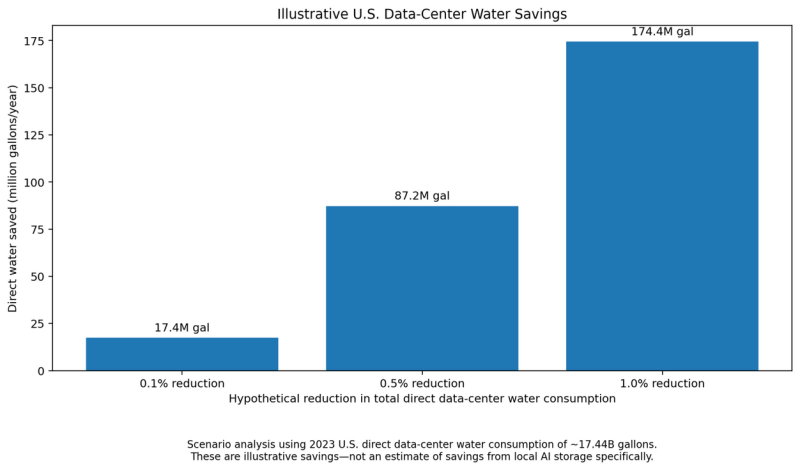
Using 2023 U.S. direct data-center water consumption merely as a baseline, a hypothetical reduction in overall direct water consumption of:
0.1% = about 17.4 million gallons per year
0.5% = about 87.2 million gallons per year
1.0% = about 174.4 million gallons per year
Those numbers are scenario calculations, not predictions of what local AI storage would save. Determining the actual savings would require knowing how much centralized storage, replication, retrieval, networking and associated cooling could genuinely be displaced—and subtracting the energy consumed by local devices.
But that's precisely why I think the question deserves investigation.
Why centralize everything?
Imagine an AI architecture in which users could choose:
Cloud storage. Local storage. Or a hybrid of the two.
A person doing extensive research or creative work could retain a complete encrypted conversation archive locally. The AI could retrieve the relevant portions when required rather than treating centralized infrastructure as the only repository for a lifetime of accumulated context.
That could provide another benefit: user-controlled continuity.
Instead of deciding between limited conversational context and indefinitely expanding centralized storage, AI developers could investigate architectures that distribute some of that responsibility to the billions of devices people already own.
We routinely discuss AI in terms of bigger models, larger data centers and greater computing capacity.
Perhaps we should also be asking the opposite question:
What information doesn't need to remain centralized?
At the scale artificial intelligence is approaching, even small efficiency improvements can become enormous when multiplied across hundreds of millions—or eventually billions—of users.
Decentralization won't solve AI's energy and water challenges by itself.
But giving users the option deserves serious consideration.
Sometimes the most efficient data center may be the storage device that's already sitting in your pocket.

6] A World of Variables, Michael Millevolte, 2026
A World of Variables. Understanding the Relationships Behind Everything, Michael Millevolte. 2026
An Exploration of Observation, Intuition, Scientific Reasoning, Human Experience, and Artificial Intelligence.
1.] Introduction. Nothing Exists in Isolation: Nearly everything we observe, experience, construct, or attempt to understand is influenced by variables. Some are obvious, others subtle, and many remain unidentified until circumstances reveal their significance.
A seemingly simple phenomenon may involve dozens of interacting physical, environmental, biological, or psychological conditions. Understanding the phenomenon requires more than identifying its visible characteristics. It requires examining the relationships responsible for its behavior.
Throughout my life, I have approached problems by identifying variables, examining their interactions, and considering how changing one condition might influence another. Much of this process developed intuitively, through observation and experience, long before I considered its relationship to formal scientific methodology.
2.] The Importance of Recognizing Missing Variables:
Identifying the variables already understood is only part of the analytical process. Equally important is recognizing that significant variables may remain undiscovered or overlooked. An explanation can appear entirely reasonable while remaining incomplete.
A.) Known Variables:
Conditions already identified and understood sufficiently to examine their influence.
B.) Unknown Variables:
Conditions that influence an outcome but have not yet been identified.
C.) Interacting Variables:
Conditions whose combined effects may differ from their individual effects.
D.) Controllable Variables:
Conditions that can be deliberately manipulated to produce or investigate a particular result.
E.) Uncontrollable Variables:
Conditions that cannot readily be manipulated but must nevertheless be considered when interpreting observations. The challenge is not necessarily identifying every conceivable variable. It is recognizing those that materially influence an outcome.
3.] Intuition and the Accumulation of Experimental Experience:
Intuition is sometimes misunderstood as reasoning without evidence. In experienced practitioners, however, intuition can develop through repeated exposure to recognizable relationships. An artist may intuitively understand how colors interact. A mechanic may recognize an engine problem by its sound. A musician may anticipate changes in rhythm without consciously calculating intervals. These abilities can emerge through observation, experimentation, repetition, and feedback.
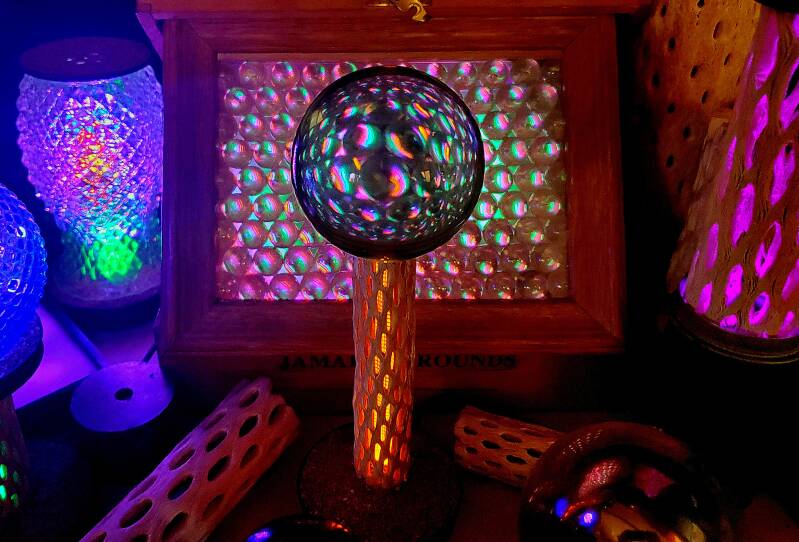
My own exploration of luminous kinetic geometry developed largely through this process. By painting geometric patterns onto rotating surfaces, I learned how their proportions, placement, and relationships influenced the resulting optical forms. The scientific terminology often came later. The phenomenon was observed first. Its governing relationships were identified through experience.
4.] A Simple Optical Phenomenon and a Complex System of Variables:
Consider a rotating surface containing predetermined hand-painted luminous geometric patterns. At first glance, the mechanism appears straightforward. A surface rotates, light illuminates its geometry, and the observer perceives changing optical forms. Yet the resulting appearance depends on numerous variables.
A.) Rotational Velocity:
Determines the rate at which geometric elements pass through successive angular positions.
B.) Geometric Pattern Size:
Influences the scale, apparent density, and overlap of luminous forms.
C.) Radial Position:
Determines the orbital circumference occupied by geometric elements.
D.) Spatial Frequency:
Describes the number of geometric repetitions per unit of distance. At a fixed rotational speed, identical angular repetitions become more closely spaced in physical distance nearer the rotational axis.
E.) Geometric Configuration:
V-shaped forms, inverted patterns, central radial lines, and overlapping compositions produce different visual relationships.
F.) Radial Count:
Influences the number of repeated geometric elements encountered during each revolution.
G.) Illumination Characteristics:
Wavelength, intensity, and temporal modulation influence the appearance of the rotating patterns.
H.) Human Visual Perception:
Temporal integration, contrast sensitivity, viewing conditions, and individual differences influence the observer's experience.
These variables do not operate independently. A change in geometric scale may alter the apparent blending of patterns. Changing their radial position modifies spatial frequency without changing rotational frequency. Changing illumination timing can produce different apparent motion or geometric arrangements. A relatively simple mechanism can therefore produce an extensive range of optical behaviors.
5.] From Artistic Observation to Functional Engineering:
My proposed Cosmic Weather Vane illustrates how an artistic understanding of variables can become the foundation of a functional instrument. The concept uses wind-driven rotation and predetermined luminous geometric patterns to produce recognizable optical transitions corresponding to approximate wind-speed ranges.
Its operation draws upon established relationships among wind-driven motion, rotational mechanics, geometric repetition, illumination, and visual perception. The challenge is selecting and calibrating these relationships to produce distinguishable, repeatable indications.
An important design distinction emerged during development. Changing the dimensions of the painted geometry does not necessarily require changing the dimensions of the supporting blade. This separates an optical design variable from a mechanical design variable. Such distinctions increase the available tuning capabilities while potentially preserving the simplicity of the underlying mechanism.
6.] Scientists, Engineers, and Lawyers Different Applications of Variable Analysis:
Scientific investigation systematically examines relationships among variables to understand natural phenomena. Engineering applies those relationships to achieve practical objectives. Legal reasoning examines evidence, circumstances, causation, and competing explanations to determine how particular facts influence an interpretation or outcome.
Although these disciplines have different objectives, they share an important analytical characteristic: conclusions depend upon the relationships among relevant conditions. A scientist asks what caused an observed result.
An engineer asks which conditions can be manipulated to produce a desired result. A lawyer may ask whether changing a particular fact would change the legal conclusion. In each case, identifying an overlooked variable can substantially alter the analysis.
7.] Emergency Medicine. When Variables Become a Matter of Life and Death:
Perhaps the most consequential example of multivariable reasoning occurs in emergency medicine. An emergency physician must evaluate numerous changing conditions, often with incomplete information and severe time constraints. Symptoms, vital signs, medical history, medications, laboratory findings, and physical examination results must be considered together.
The physician must identify which variables are immediately important, distinguish competing explanations, and determine which interventions cannot safely wait. A seemingly minor observation may change the interpretation of an entire clinical presentation. Unlike many scientific or engineering investigations, emergency medicine frequently does not allow extensive experimentation before action becomes necessary.
The physician must make decisions while uncertainty remains. This requires a combination of medical knowledge, experience, pattern recognition, analytical reasoning, and judgment.
Research into diagnostic safety recognizes both the importance of these cognitive processes and the dangers of overlooking information or prematurely accepting a diagnosis.
8.] Artificial Intelligence. Expanding Our Capacity to Examine Variables:
Artificial intelligence introduces another dimension to multivariable analysis. Computational systems can examine extensive datasets, identify statistical relationships, compare alternative explanations, and assist in recognizing patterns that might otherwise escape attention.
This capability has particular potential in emergency medicine, where information arrives rapidly and decisions must often be made under pressure. AI-assisted clinical systems could help organize patient information, suggest alternative diagnoses, recognize concerning trends, and reduce cognitive workload. However, identifying a statistical relationship does not automatically establish causation.
AI systems can also overlook relevant information, reproduce biases, and generate incorrect conclusions. Research therefore emphasizes careful validation and the use of AI to support, rather than replace, clinical judgment. The most promising relationship is not human intelligence versus artificial intelligence, but human judgment supported by computational analysis.
9.] Human Experience. Learning to Recognize Relationships: Our understanding of variables is not confined to professional or scientific activity. Personal experiences can influence how we approach uncertainty, risk, opportunity, and problem-solving.
Difficult circumstances may encourage closer attention to changing conditions, particularly when understanding those conditions becomes important to navigating them. Over time, the habit of examining relationships can extend beyond the circumstances that originally encouraged it.
An individual may begin applying the same reasoning to mechanical problems, artistic composition, interpersonal relationships, financial decisions, or everyday observations.
Yet human behavior introduces additional complexity. People are not predictable mechanical systems. Their decisions involve individual histories, changing circumstances, subjective experiences, and imperfect information. Recognizing these limitations is itself an important part of responsible variable analysis.
10.] The Difference Between Complexity and Complication:
A system can be mechanically simple while exhibiting complex behavior. Conversely, adding more components does not necessarily produce a better understanding of how a system operates. Complexity can arise from interactions among relatively few elements.
The objective of analytical reasoning is therefore not to complicate an explanation unnecessarily. It is to identify the relationships essential to understanding the phenomenon.
A) In engineering, this may allow a simple mechanism to perform a sophisticated function.
B) In medicine, it may help identify the critical observation among numerous competing details.
C) In art, it may reveal how relatively simple geometric relationships produce unexpectedly rich perceptual experiences.
11.] The Limits of Variable Analysis:
No investigation can account for every possible variable. Some conditions are difficult to measure. Others change unpredictably. Certain relationships may be too complex to isolate using available methods.
There is also a danger in assuming that identifying additional variables necessarily improves an explanation. A useful variable must contribute to understanding, prediction, or practical decision-making. Effective analysis therefore requires both curiosity and discrimination. The ability to recognize a missing variable is valuable. The ability to determine whether that variable matters is equally important.
12.] Conclusion and a Way of Looking at the World:
In my experience examining variables is more than a scientific technique. It is a way of observing and understanding the world. Whether investigating an optical phenomenon, designing a kinetic sculpture, examining a mechanical problem, or considering the complexities of human experience, I find myself returning to the same questions.
*What conditions determine the outcome?
*How do those conditions interact?
*Which variables can be changed?
*What important relationship might I have overlooked?
*What happens when one variable changes?
These questions do not guarantee an answer. They provide a method for searching for one.
The natural world is filled with relationships that remain invisible until we begin examining the conditions responsible for them. Some discoveries require sophisticated instruments and extensive research. Others begin with a simple observation and the recognition that something important has not yet been considered.
The world does not become more complicated because we recognize its variables. We become more capable of understanding the complexity that was already there.
Michael Millevolte. 2026


7] Beyond Corporate Art Institutions, Michael Millevolte. 2026
Beyond Corporate Art Institutions and the Traditional Gallery System
Michael Millevolte, 2026
1.] Introduction: How Should an Artist's Influence Be Measured?
How should an artist's influence be measured? By institutional recognition, auction prices, critical reviews, technical innovation, or the number of people who have actually experienced the work?
For more than four decades, I have pursued a career in kinetic light sculpture that has taken me through nightclubs, restaurants, galleries, entertainment venues, national retail environments, and unconventional public exhibition spaces. My work has appeared before audiences who were not necessarily looking for art. They encountered it while dining, dancing, shopping, walking through New York City, attending performances, or simply enjoying an evening out. Some stopped for a moment. Others remained for hours. Many returned repeatedly. This was not an accidental consequence of my career. It was an intentional approach to bringing art directly into people's lives.
This raises an important question concerning the historical evaluation of contemporary art: Can an artist operating largely outside established institutional structures achieve a greater degree of public exposure than artists whose reputations are primarily associated with museums, commercial galleries, and private collections?
2.] The Traditional Institutional Model: Recognition Versus Public Accessibility
The conventional art world has historically relied upon museums, galleries, critics, curators, collectors, and academic institutions to establish artistic significance. These organizations perform important functions in preserving, interpreting, and documenting cultural achievements. However, institutional recognition and actual public exposure are not necessarily equivalent.
A sculpture displayed in a prestigious gallery may be viewed by several hundred or several thousand visitors during an exhibition. A work acquired by a private collector may subsequently disappear from public view for decades. By comparison, an artwork installed in a heavily trafficked restaurant, nightclub, retail establishment, or public entertainment venue may be encountered by hundreds or thousands of individuals every day, sometimes remaining in operation for years.
The distinction is particularly significant for kinetic light sculpture, an artistic discipline in which movement, illumination, optical transformation, and the surrounding environment contribute directly to the experience. My objective was never simply to place objects in front of audiences. It was to create environments in which art became an active participant in everyday human activity.
3.] An Alternative Exhibition History: New York City and Beyond
Beginning in the 1980s and continuing through subsequent decades, my optomechanical sculptures appeared in numerous commercial, cultural, and entertainment environments. These included El Teddy's, Roseland Ballroom, Scrap Bar, Antique Boutique, World nightclub, and other New York City establishments, along with exhibitions and installations extending into national retail environments, public performances, and special events.
Unlike conventional gallery exhibitions, many of these installations operated continuously during normal business hours, sometimes for years. Visitors were not required to purchase admission to an art exhibition, understand the terminology of contemporary sculpture, or possess prior knowledge of kinetic art. The artwork was simply there, functioning within the environment.
This accessibility created a different relationship between artist and audience. The sculptures were experienced repeatedly, often under changing lighting conditions and from different viewing positions, producing new optical effects with each encounter.
4.] Quantifying Public Exposure: An Alternative Measure of Artistic Reach
Estimating the total number of individuals who encountered my work requires distinguishing between unique visitors, repeat encounters, installation attendance, retail distribution, and the duration of individual exhibitions. Exact historical attendance records are not available for every installation. Nevertheless, approximate estimates can be developed using venue capacities, pedestrian traffic, operating schedules, exhibition durations, and documented commercial distribution.
The following figures represent working estimates of cumulative public encounters or commercial distribution associated with selected installations and projects. They should not be interpreted as independently verified counts of unique individuals.
A.) Elizabeth Street, Little Italy, New York City: 450,000+ Estimated Experiences. My installations along Elizabeth Street occupied an environment characterized by substantial pedestrian activity, neighborhood commerce, restaurants, and visitors exploring Lower Manhattan. Extended visibility within this setting provided opportunities for repeated public encounters outside conventional exhibition structures.
B.) El Teddy's, TriBeCa, New York City: 3,500,000+ Estimated Experiences. El Teddy's provided one of the most significant extended exhibition environments for my kinetic light sculpture. Its combination of restaurant activity, nightlife, and sustained public attendance created opportunities for repeated exposure over an extended operating period. The installation was not a temporary gallery presentation. The sculptures became part of the establishment's visual identity and atmosphere.
C.) Barneys New York, Red Window Installations: 1,500,000+ Estimated Experiences. Retail window installations introduced kinetic optical artwork to a broad pedestrian audience. Unlike gallery visitors, people passing storefront windows could experience the work without entering the establishment. A single installation can reach substantial audiences through continuous visibility in a heavily traveled urban setting.
D.) Antique Boutique, New York City: 450,000+ Estimated Experiences. My work appeared within the distinctive commercial and cultural environment of Antique Boutique, where unconventional design, fashion, and nightlife intersected. The installation reached an audience whose primary purpose was not necessarily to attend an art exhibition.
E.) Spencer Gifts, National Retail Distribution: 500,000+ Units Sold. Between approximately 1998 and 2001, my commercial involvement with Spencer Gifts extended optical and kinetic visual concepts into a national retail environment. An estimated 500,000 units were sold through this distribution channel. This figure represents product distribution rather than individual artwork viewers and therefore constitutes a separate measure of commercial reach. Its potential audience extends beyond purchasers to include individuals encountering retail demonstrations, store displays, and products subsequently used in homes and other environments.
F.) Additional Exhibitions, Installations, and Public Encounters. Other venues and projects contributed substantially to the cumulative audience, including Roseland Ballroom, Scrap Bar, World nightclub, entertainment productions, special events, additional retail environments, and exhibitions outside New York City. These installations varied considerably in duration, attendance, and presentation format. Some operated continuously, while others reached concentrated audiences during individual performances or events.
5.] The Cumulative Audience: An Estimated 22,450,000+ Physical Experiences
Combining the broader historical exhibition record produces a working estimate of more than 22,450,000 cumulative physical experiences associated with my kinetic light sculpture and related optical installations. This figure is an estimate rather than a verified attendance total. It incorporates assumptions concerning venue traffic, exhibition duration, repeated exposure, and additional installations for which complete historical records are unavailable. The individually identified estimates in Section 4 do not, by themselves, account for the entire cumulative figure; a complete venue-by-venue accounting would be necessary to substantiate the remainder.
Importantly, cumulative experiences are not equivalent to unique individuals. Someone who encountered a sculpture repeatedly over several years may account for multiple experiences. For kinetic sculpture, however, repeated encounters have particular artistic significance. A moving optical composition can change continuously with rotational speed, lighting frequency, viewing angle, and environmental conditions. An individual experiencing the same sculpture on multiple occasions may perceive different visual structures and transformations.
Consequently, the number of encounters is itself a meaningful measure of artistic exposure, provided that the methodology is clearly distinguished from unique audience counts.
6.] Direct Comparisons: Traditional Gallery Exhibitions Versus Alternative Public Exhibition Spaces
The estimated 22,450,000 cumulative physical experiences associated with my exhibition history provide an opportunity to examine the relationship between institutional recognition and public accessibility. The following comparisons place individual installations alongside conventional gallery and museum exhibition models. The gallery attendance figures are illustrative benchmarks rather than verified industry averages.
A.) Traditional Solo Gallery Exhibition Versus Elizabeth Street Storefront Galleries: A conventional solo exhibition in a commercial gallery might attract approximately 300–1,500 visitors over a month. By comparison, my Elizabeth Street storefront installations in Little Italy, New York City, generated an estimated 450,000+ public encounters over six years. Unlike conventional galleries, these storefront installations remained visible to pedestrians regardless of whether they intended to visit an art exhibition. The distinction demonstrates how sustained public accessibility can produce substantially greater cumulative exposure than short-term gallery exhibitions.
B.) Museum Residency Versus El Teddy's, TriBeCa: A three-month museum exhibition attracting approximately 50,000 visitors would generally be considered a substantial public presentation. By comparison, my kinetic light sculptures at El Teddy's accumulated an estimated 3,500,000+ experiences over approximately ten years. This represents roughly 70 times the cumulative exposure of the illustrative museum exhibition. The sculptures were integrated into the restaurant's architectural and entertainment environment, creating opportunities for repeated observation rather than a single scheduled exhibition experience.
C.) Traditional Group Exhibition Versus Barneys New York Red Windows: A conventional gallery group exhibition might attract approximately 5,000–20,000 visitors. By comparison, my 1994 kinetic installation in the Barneys New York Red Windows, displayed alongside Giorgio Armani, had an estimated potential exposure of 1,500,000+ pedestrian encounters over approximately 50 days. This represents approximately 75–300 times the attendance of the illustrative gallery exhibition. The installation's street-level visibility introduced experimental kinetic sculpture to a large urban audience without admission requirements or institutional barriers.
D.) Gallery Exhibition Versus Antique Boutique, West Broadway: Traditional commercial gallery exhibitions generally operate for several weeks, limiting their exposure to visitors attending during that period. My kinetic installations at Antique Boutique on West Broadway remained publicly accessible for approximately four years, generating an estimated 450,000+ experiences. The extended exhibition period and integration into an established retail environment created sustained public visibility that would be difficult to reproduce through a single conventional gallery exhibition.
E.) Gallery Catalogues and Reproductions Versus Spencer Gifts National Distribution: A traditional gallery exhibition might distribute approximately 500–1,000 catalogues, prints, or reproductions, depending upon the artist and exhibition. By comparison, approximately 500,000+ Orbitron units were sold through Spencer Gifts' national retail distribution network. This represents approximately 500–1,000 times the illustrative gallery reproduction distribution. Although commercial product sales are not equivalent to individual exhibition visitors, the comparison demonstrates the extraordinary potential of national retail distribution to introduce optical and kinetic visual concepts to audiences beyond conventional fine-art institutions.
F.) Cumulative Career Exposure Versus Traditional Gallery Representation: My estimated cumulative exhibition history exceeds 22,450,000 physical experiences across restaurants, nightclubs, storefronts, retail establishments, public performances, and other exhibition environments. Under the comparative assumptions developed for this article, this could represent approximately 40–80 times the cumulative exposure achieved by an established artist whose career is primarily associated with conventional commercial gallery exhibitions. These comparisons concern estimated cumulative encounters rather than verified unique visitors. The gallery attendance figures are illustrative benchmarks, while my own historical estimates remain subject to further documentation.
G.) Institutional Prestige Versus Actual Public Engagement: These comparisons reveal a fundamental distinction between artistic recognition and public accessibility. A gallery exhibition may generate critical attention, institutional credibility, and commercial value while reaching a relatively small audience. Conversely, an unconventional public installation may reach hundreds of thousands or millions of people without receiving comparable institutional acknowledgment. The location of an artwork does not determine its technical originality, aesthetic significance, or historical importance. Nor should the prestige of an exhibition venue automatically outweigh the documented scale of public engagement.
7.] The Difference Between Viewing an Object and Experiencing an Environment
Kinetic light sculpture differs fundamentally from many static artistic disciplines. A painting can remain visually stable while the observer changes position. An optomechanical sculpture introduces additional variables, including mechanical movement, rotational velocity, illumination frequency, color interaction, persistence of vision, and temporal optical transformation.
My sculptures frequently produce luminous geometric structures that appear to occupy space independently of their physical mechanisms. Rotating fluorescent patterns can generate apparent transparent forms, expanding geometric volumes, intersecting planes, and visual phenomena that cannot be adequately understood through still photography. These effects are experienced directly through human visual perception.
When such sculptures operate within restaurants, nightclubs, and entertainment environments, they become part of a continuously changing visual field. Music, ambient lighting, human movement, and architectural surroundings contribute to the experience. The artwork is not merely displayed within the environment. It actively transforms the environment.
8.] Technical Innovation and Artistic Recognition
My work has involved the development of original optomechanical methods combining mechanical movement with controlled illumination to generate apparent luminous geometry. These investigations produced patented technologies, including United States Patents 5,704,145 and 6,018,899, associated with fluorescent optical effects and motion. The underlying principles involve interactions between moving pigmented surfaces, illumination, and the temporal characteristics of human vision.
These methods emerged through independent experimentation rather than institutional research programs. Over subsequent decades, the same investigative approach expanded into rotating optical matrices, suspended kinetic structures, laser-based systems, programmable illumination, and modular sculptural environments.
Technical originality can be evaluated independently of institutional representation. Patents, surviving artworks, engineering documentation, photographic records, and historical installations provide evidence that can be examined directly. Recognition and invention are separate matters. An artist does not become technically innovative because an institution acknowledges the work; the innovation exists whether or not that acknowledgment occurs.
9.] The Role of Nightlife and Commercial Environments in Art History
Nightclubs, restaurants, and entertainment venues have played important roles in the development of modern visual culture. These environments have historically brought together artists, musicians, designers, performers, architects, and audiences in ways that conventional exhibition spaces do not always accommodate. Yet the artistic contributions associated with nightlife and commercial interiors are frequently underrepresented in institutional histories.
Installations disappear when businesses close. Architectural interiors are renovated. Equipment is dismantled, sold, or discarded. Documentation may survive only in photographs, personal archives, press coverage, and the memories of participants. This creates an archival imbalance.
An artwork preserved in a museum collection may remain accessible to future historians, while a technologically innovative installation experienced by hundreds of thousands of people can effectively vanish from the historical record. The disappearance of the physical installation does not diminish the significance of the original achievement. It demonstrates the importance of reconstructing exhibition histories beyond the traditional museum and gallery system.
10.] The Press, Public Documentation, and Historical Visibility
Press coverage provides another important means of establishing an artist's historical presence. My work has received attention from publications including the Milwaukee Journal Sentinel and New York Press, alongside other media and exhibition documentation accumulated over several decades. Such coverage is particularly valuable when evaluating unconventional artistic careers because it establishes evidence of public activity outside traditional institutional catalogues.
Newspaper articles, exhibition announcements, historical photographs, commercial records, and surviving artworks can collectively document the circumstances in which an artist's work was presented. However, media recognition should not be confused with artistic merit any more than institutional recognition should.
A substantial newspaper feature can establish historical visibility, but the artistic and technical achievements themselves must still withstand critical examination. The appropriate objective is to assemble a verifiable record connecting invention, artistic development, exhibition history, public exposure, and independent documentation.
11.] Commercial Success Does Not Eliminate Artistic Significance
The relationship between fine art and commercial activity has long been complicated. Artists whose work enters commercial environments are sometimes evaluated differently from those operating exclusively through galleries, museums, and private collectors. Yet the location of an artwork does not determine its originality, technical sophistication, or cultural value.
A kinetic sculpture installed in a restaurant can embody the same experimental principles as one displayed in a museum. A luminous optical installation experienced by thousands of nightclub patrons does not become less innovative because the audience is dancing rather than standing silently before it.
Commercial distribution can also introduce new artistic technologies to audiences who might never encounter them through institutional exhibitions. The relevant distinction is not simply commercial versus noncommercial. It is whether the work demonstrates original artistic thinking, technical development, and a meaningful contribution to visual culture.
12.] The Importance of Repeated Public Encounters
One of the most overlooked aspects of extended kinetic installations is the value of repeated exposure. A visitor attending a temporary exhibition may experience an artwork once. A restaurant patron, nightclub regular, employee, or neighborhood resident may encounter the same sculpture dozens or hundreds of times.
For static works, repeated viewing can reveal previously unnoticed compositional details. For kinetic optical sculpture, repeated viewing can also reveal changing temporal relationships, unexpected geometric transformations, and visual effects dependent upon the observer's position.
My installations were frequently designed to sustain this kind of ongoing engagement. The sculptures were not intended merely to produce an immediate spectacle. Their continually changing optical behavior encouraged prolonged observation and repeated discovery. This distinction supports the use of cumulative experiences as one measure of public engagement, while acknowledging that such experiences cannot be equated directly with unique audience size.
13.] Institutional Recognition and the Problem of Historical Selection
Art history is not simply a record of everything artists have created. It is a selective process shaped by preservation, scholarship, collecting practices, institutional priorities, documentation, and access to historical evidence. Consequently, important developments can remain outside established narratives for extended periods.
Artists working independently, particularly those using unconventional technologies or exhibition environments, may be difficult to categorize within existing institutional frameworks. Their work may cross boundaries between sculpture, optical science, mechanical engineering, lighting design, and environmental installation. Such interdisciplinary practices can challenge conventional definitions of artistic media.
The appropriate response is not to dismiss institutional scholarship, but to expand the historical record through careful documentation and critical investigation. Institutions remain essential to the preservation and interpretation of art. Their authority, however, should be exercised through examination of evidence rather than through the assumption that institutional visibility is synonymous with artistic importance.
14.] Beyond the Gallery: Art as a Public Experience
My career has been guided by the belief that art should not depend exclusively upon specialized institutions for its audience. The traditional gallery remains a valuable environment for focused contemplation, scholarship, and preservation. But it is only one of many places where meaningful artistic experiences can occur.
Nightclubs, restaurants, storefronts, public corridors, entertainment venues, and other shared environments can expose large and diverse audiences to original artistic ideas. These settings also introduce audiences who may not ordinarily visit contemporary art exhibitions.
For kinetic light sculpture, the surrounding environment can become an essential part of the artwork's operation. Movement, illumination, architecture, and human activity interact continuously. The result is an artistic experience that exists not only within a physical object, but also within the changing relationship between that object and its audience.
15.] Measuring Artistic Influence Through Multiple Forms of Evidence
A comprehensive assessment of an artist's influence should consider several independent dimensions rather than relying upon a single institutional or commercial measurement.
A.) Technical Originality: The development of new artistic methods, mechanisms, materials, or perceptual effects.
B.) Historical Priority: Evidence establishing when particular artistic innovations were conceived, constructed, exhibited, or published.
C.) Public Exposure: The approximate number of people or cumulative encounters associated with the work.
D.) Duration of Exhibition: The length of time artworks remained accessible and operational.
E.) Geographic Distribution: The range of locations and cultural environments in which the work appeared.
F.) Critical and Documentary Recognition: Independent press coverage, scholarly discussion, exhibition records, patents, and archival materials.
G.) Cultural and Artistic Influence: Evidence that the work contributed to subsequent artistic developments, technological practices, or public understanding.
No single measurement can establish artistic significance. An artist may achieve exceptional technical innovation without attracting a large audience. Another may achieve enormous public visibility without introducing substantially new artistic ideas. The strongest historical evaluations consider originality, documentation, public engagement, and influence together.
16.] Conclusion: The Audience Is Part of the Historical Record
For more than forty years, my work has occupied a space between art, engineering, optical science, and public entertainment. Its exhibition history has developed through both conventional and unconventional settings, frequently reaching audiences who encountered the sculptures as part of everyday life.
The estimated 22,450,000+ cumulative physical experiences associated with this history represent an attempt to quantify a dimension of artistic activity that traditional institutional records often overlook. The figure remains subject to refinement as additional historical documentation becomes available. Its importance lies not in claiming an exact count of unique viewers, but in recognizing the substantial public exposure that sustained unconventional exhibitions can generate.
The direct comparisons with conventional gallery and museum exhibitions demonstrate the scale of this alternative exhibition model. My estimated 3,500,000 experiences at El Teddy's alone represent approximately 70 times the attendance of an illustrative museum exhibition attracting 50,000 visitors. The estimated 1,500,000 encounters associated with the Barneys New York Red Windows represent approximately 75–300 times the attendance of an illustrative commercial gallery group exhibition attracting 5,000–20,000 visitors. Across my broader exhibition history, the estimated cumulative exposure could represent 40–80 times that of certain gallery-based careers under the comparative assumptions presented. These comparisons are illustrative, not verified industry-wide measurements.
These differences do not diminish the importance of museums and galleries. They demonstrate that substantial artistic exposure can occur through alternative cultural environments and that such exposure deserves recognition within historical evaluation.
Museums and galleries provide indispensable services in preserving and interpreting art. But the historical significance of an artist's work cannot be determined solely by whether it entered those institutions. Original invention, sustained public engagement, technical achievement, and documented exhibition history deserve consideration wherever they occur.
My objective has never been to reject the traditional art world. It has been to demonstrate that meaningful artistic innovation and substantial public engagement can develop beyond its established boundaries.
Ultimately, art history should concern itself not only with which artists were selected for institutional recognition, but also with what those artists created, what they contributed to their disciplines, and how their work entered the lives of others.
An artwork does not require institutional permission to become part of cultural history. Its achievements exist independently of recognition. The responsibility of art history is to discover, examine, and accurately document them.
Michael Millevolte
Optomechanical Illusionist
2026

8.] Live Events Over Gallery Openings, Michael Millevolte. 2026:
Live Events Over Gallery Openings, Michael Millevolte. 2026:
My earliest exhibitions took place not in traditional art galleries, but at large house parties throughout Madison, Wisconsin, where live bands were performing. At the time, my wall of blacklight-reactive window-box fans was all I had, but it was all I needed. The fans created luminous kinetic effects while serving a practical purpose: circulating air and keeping the musicians cooler during their performances.
When attending crowded parties, where temperatures could become uncomfortable, the gentle breeze coming from the stage was appreciated by musicians and audiences alike. Bands loved the combination of functional ventilation and visual effects, and musicians began requesting my wall of blacklight reactive Fans for their own performances.
From the very beginning, my art career developed alongside the music industry, establishing relationships with musicians and DJs. Many of those exhibitions extended well beyond the original events, often developing into friendships and new opportunities.
Throughout my career, my light works have rarely been exhibited without musical accompaniment, whether through live bands or DJs. This relationship evolved naturally into nightclub and restaurant installations, commissions, special events, and performances.
My storefront galleries in New York City were not primarily established to sell artwork. They served as showcases for securing exhibitions, commissions, and permanent installations at venues including the Barneys Red Windows Holiday Exhibition, my Absolut Millevolte POP displays, Spencer Gifts contract, The Orb at Roseland Ballroom, El Teddy's restaurant, Aldo's Danceclub (New Jersey), Nickelodeon On-Air Animation Lobby, Antique Boutique, and a weekly sound engineering gig at The Continental, NYC to help cover my electric bills.
There was a profound economic advantage to this approach. Traditional galleries require funding to maintain their exhibition spaces, and artists frequently encounter situations where they must PAY for the opportunity to display their work. My experience was often the opposite. In an art world where artists are regularly confronted with pay-to-play hustles and schemes, I was getting paid to exhibit my artwork.
Much like musicians who are compensated for performing without having to sell their instruments, I could earn income by presenting my kinetic instruments of light without relinquishing ownership of them. This significantly reduced the pressure to continually produce artwork for sale, meet production deadlines, and absorb the material expenses associated with replacing sold pieces. Furthermore, some of my creations were simply too personally significant to part with.
However, there is an important distinction. Before an artist can earn income from repeatedly exhibiting an instrument of artistic expression, that instrument must first exist. In my case, this meant inventing, designing, engineering, fabricating, and refining kinetic light sculptures capable of producing unique optical experiences. The sculptures were not merely objects to be displayed; they were instruments through which luminous geometric illusions, motion, color, and light became an ongoing visual performance.
Developing these instruments required substantial investments of time, materials, experimentation, technical knowledge, and artistic innovation. Creating something that had not previously existed, making it function reliably, and developing an audience willing to pay to experience it was no small undertaking. The economic advantages of repeated exhibitions could only be realized after the instruments themselves had been successfully developed.
This also explains why such a business model is not easily replicated by other artists. While certain forms of immersive installation, kinetic sculpture, and performance art can support similar approaches, relatively few artists create original optical instruments capable of generating distinctive, repeatable visual experiences that can be incorporated into live entertainment and commercial environments. My business model was not simply an alternative marketing strategy. It emerged from the particular nature of my artistic inventions and their ability to function as both independent artworks and instruments of visual performance.
Live events also created their own momentum. One performance could lead to another, generating additional engagements, permanent installations, commissions, and occasionally direct artwork sales. The opportunity to sell artwork was never eliminated; it simply became one of several possibilities rather than the primary objective.
Perhaps the greatest advantage was the ability to retain ownership of more of my creations. Each sculpture could continue generating opportunities through repeated exhibitions and performances, allowing my body of work to grow rather than continually diminish through sales.
There is another important consideration: the willingness of venues, musicians, and event producers to compensate me for exhibiting my work provided a form of professional validation independent of the traditional gallery system. Once people experienced the sculptures in operation, they frequently wanted them incorporated into their own performances and environments. My artwork demonstrated its value through the demand for its presentation rather than through the price someone was willing to pay to own it.
The traditional gallery model often emphasizes the sale of artwork. My approach emphasizes its continuing value through presentation, and each presentation was an energetic and dynamic party with live entertainment.
The economic model followed the artistic innovation, not the other way around. I first had to create the instruments capable of producing these unique optical experiences. Only then could I develop a sustainable practice around exhibiting them.
I discovered that I didn't necessarily have to sell my artwork to make a living as an artist. I could make a living by exhibiting it.
